When your Hyundai or Kia touchscreen starts ghost-touching, bubbling, or going completely dark, the instinct is to find the cheapest fix. A quick Amazon or AliExpress search turns up digitizers for $30–$80. A Cuescreens replacement runs $199. So what’s the difference — and does it matter?
It does. Here’s a straight comparison.
The Core Difference: What You're Actually Buying
A cheap digitizer is a component. A Cuescreens screen is a tested, warranted, supported product built specifically for automotive use.
That distinction sounds like marketing. It isn’t. Here’s what it means in practice.
Build Quality & Materials
Cheap Amazon / AliExpress Digitizers
- Sourced from generic overseas factories with inconsistent quality control
- Gel-based adhesive layers that bubble, delaminate, and trap moisture over time
- Standard touch chips with no optimization for automotive temperature ranges
- No anti-glare or anti-fingerprint treatment
- Variable LCD quality — color accuracy and brightness differ unit to unit
Cuescreens
- Gel-free construction that permanently eliminates the bubbling and delamination that killed your original screen
- NanoTouch™ Ultra-Responsive Chip — 40% faster touch response than OEM, with zero-lag multitouch
- HD display with high light transmission, anti-glare, and anti-fingerprint enhancement
- Built and tested specifically for the TDO-0797F00136 V3 infotainment system used across 19 Hyundai & Kia models
Testing Standards
Cheap Amazon / AliExpress Digitizers
Most generic digitizers are bench-tested for basic functionality — does the screen turn on, does touch register. That’s it. There is no automotive-grade testing for heat cycles, vibration, humidity, or UV exposure. A screen that works fine in a warehouse may fail within months inside a car dashboard.
Cuescreens
Every Cuescreens unit is tested across four dimensions before it ships:
- Temperature testing — validated across the full range a car interior experiences, from cold starts to peak summer heat
- Vibration testing — simulates road conditions to ensure the digitizer bond holds over time
- Pressure testing — confirms touch accuracy under real-world input
- Functional testing — every screen verified for display quality, touch response, and connectivity before shipment
These aren’t OEM standards. They exceed them.
Warranty & Support
Cheap Amazon / AliExpress Digitizers
- Typically 30–90 day warranty, if stated at all
- Returns routed through third-party sellers with slow or nonexistent response
- No installation support
- No installer network
- If it fails after 90 days, you buy another one
Cuescreens
- Lifetime warranty — not 90 days, not one year. Lifetime.
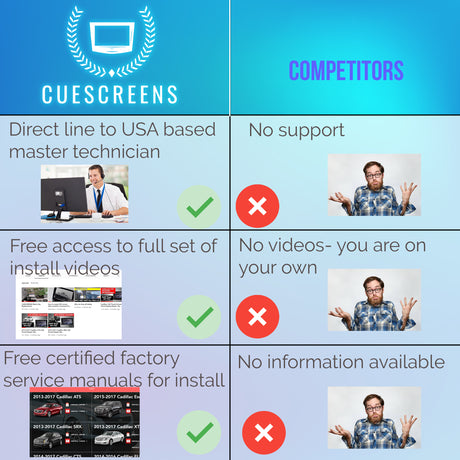
- Direct access to Cuescreens customer support
- Installation video guidance included
- Access to a nationwide installer network if you’d rather not DIY
- Over 100,000 customers served
The Real Cost Comparison
The price difference looks obvious on the surface. But the math changes when you factor in the full picture.
| Factor | Cheap Digitizer (Amazon / AliExpress) | Cuescreens |
|---|---|---|
| Upfront cost | $30–$80 | $199 |
| Warranty | 30–90 days | Lifetime |
| Automotive-grade testing | No | Yes |
| Gel-free construction | Rarely | Yes |
| Touch performance vs. OEM | Equal or worse | 40% faster |
| Installation support | None | Video + installer network |
| Failure rate | High (especially in heat) | Low |
| Cost if screen replaced twice | $60–$160 + your time | $0 (lifetime warranty covers it) |
| vs. Dealership replacement | Still cheaper — until it fails | Fraction of $1,500–$3,000 dealer cost |
Two failed cheap screens plus your time to reinstall often costs more than one Cuescreens unit with a lifetime warranty. And neither comes close to the $1,500–$3,000 a dealership charges to replace the entire head unit — a repair you almost certainly don’t need.
Who Should Buy a Cheap Digitizer?
Honestly? Almost nobody with a daily driver.
Cheap digitizers make sense if you’re parting out a vehicle, testing a repair hypothesis before committing, or working on a project car where longevity doesn’t matter. For any car you rely on every day, the economics favor a quality screen with a real warranty over a cheap one you may be reinstalling in six months.
Bottom Line
If your Hyundai or Kia touchscreen is failing, you have three options: pay $1,500–$3,000 at the dealership, buy a cheap replacement and hope it holds, or buy a Cuescreens unit that’s tested beyond OEM standards and warranted for life.
The cheap option looks like the smart one until it isn’t. Cuescreens exists for drivers who want to fix it once and be done with it.
Frequently Asked Questions
Are cheap Amazon digitizers safe for my car?
They may work initially, but most aren’t tested for automotive conditions — heat, vibration, and UV exposure. Failure rates are significantly higher than automotive-grade screens, and warranties are minimal or nonexistent.
Why is Cuescreens more expensive than Amazon alternatives?
The price includes comprehensive automotive-grade testing, gel-free construction, a lifetime warranty, customer support, and access to a nationwide installer network. You’re buying a product, not just a part.
What happens if a cheap digitizer fails?
You buy another one and reinstall it. Most cheap screens carry 30–90 day warranties. After that, the cost is entirely yours. Two replacements plus your time often exceeds the price of one Cuescreens unit with a lifetime warranty.
Does Cuescreens offer better touch performance than OEM?
Yes. The NanoTouch™ Ultra-Responsive Chip delivers 40% faster touch response than the original OEM screen, with zero-lag multitouch and stronger resistance to heat and humidity.
About the Author
Daniel Gigante has over 18 years of experience in the automotive industry, with a focus on vehicle technology, infotainment systems, and real-world reliability. He writes about automotive design, touchscreen usability, and how modern technology impacts everyday driving.
![[Premium] Upgraded Gel-Free Cadillac CUE Replacement Touch Screen Display-Cuescreens](http://www.cuescreens.com/cdn/shop/files/7c1892_b5fcaf040dfe42abb289e47b1fa91ab9_mv2.png?v=1738265347&width=460)


![[Premium] Upgraded Gel-Free Cadillac CUE Replacement Touch Screen Display-Cuescreens. Supports Proximity Sensors.](http://www.cuescreens.com/cdn/shop/files/7c1892_7faa9297eab444d5a99838357b9c178c_mv2.png?v=1764720901&width=460)