If you’ve dealt with a cracked, unresponsive, or “ghost-touching” car screen, there’s a good chance the issue wasn’t the LCD — it was the gel layer. Understanding the difference between gel-based and gel-free touchscreens can help you avoid repeat failures, wasted money, and unnecessary replacements.
This guide breaks down how each technology works, why gel screens fail so often, and why gel-free touchscreens are becoming the preferred long-term solution for vehicle infotainment repairs.
What Is a Gel Touchscreen?
Traditional automotive touchscreens use a gel bonding layer between the glass digitizer and the underlying LCD. This gel is designed to:
- Improve touch sensitivity
- Absorb vibration
- Allow light to pass through cleanly
When new, gel-based screens often work well. The problem is how they age.
Why Gel Touchscreens Fail Over Time
Gel is not a permanent bonding solution. In vehicles, it’s exposed to:
- Heat cycles (summer dashboards, winter cold starts)
- UV exposure
- Humidity and condensation
- Constant vibration
Over time, the gel can dry out, liquefy, or migrate, leading to common failures like:
- Ghost touch (random inputs)
- Delamination (bubbling or separation)
- Dead zones or delayed response
- Cloudy or distorted visuals
This is especially common in systems like Cadillac CUE, Uconnect, and other large-format infotainment screens.
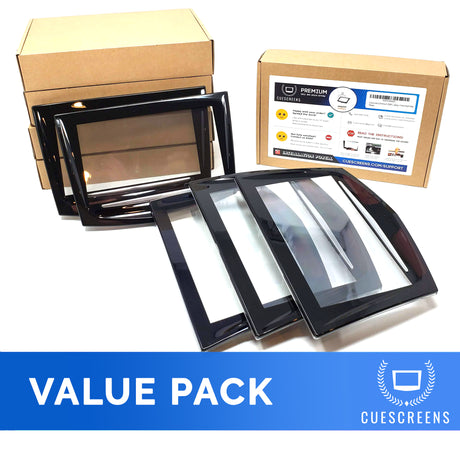
If you're experiencing these issues, consider one of our premium gel-free replacements.
What Is a Gel-Free Touchscreen?
A gel-free touchscreen eliminates the liquid bonding layer entirely. Instead, it uses:
- Solid-state optical bonding
- Laminated glass construction
- Precision adhesives that don’t migrate or degrade
The result is a screen that behaves more like modern smartphone displays — stable, predictable, and far more durable over time.
Key Differences: Gel vs Gel-Free Touchscreens
Durability
Gel-based screens degrade as the gel ages. Gel-free screens maintain structural integrity for years without internal breakdown.
Touch Accuracy
Gel movement can cause false inputs. Gel-free screens provide consistent, accurate touch response with no ghosting.
Heat Resistance
Gel is sensitive to temperature extremes. Gel-free construction handles dashboard heat far better.
Visual Clarity
As gel breaks down, screens can look cloudy or uneven. Gel-free displays maintain sharp contrast and clarity.
Long-Term Reliability
Gel screens often fail again after replacement. Gel-free screens are designed to be a permanent fix, not a temporary repair.
Why Dealers Still Use Gel Screens
Many dealerships replace the entire infotainment unit, even when only the touchscreen has failed. These replacements often use the same gel-based design, which means:
- Higher cost
- No improvement in failure rate
- Risk of the same issue returning
Gel-free upgrades aren’t always offered because they require component-level solutions rather than full module swaps.
Are Gel-Free Touchscreens Worth It?
For most vehicle owners, yes — especially if you plan to keep your car.
Gel-free touchscreens are ideal if you want:
- A long-term fix instead of repeat repairs
- Improved touch accuracy
- Better heat resistance
- OEM-level or better performance
They’re particularly valuable for high-failure systems where gel degradation is the root cause of the problem.
TL;DR
- Gel touchscreens rely on a liquid layer that breaks down over time
- Gel-free touchscreens use solid bonding for better durability
- Gel failure causes ghost touch, delamination, and dead zones
- Gel-free screens are more heat-resistant, accurate, and reliable
- For long-term ownership, gel-free is the smarter choice
If touchscreen failure keeps coming back, the issue may not be how it was replaced — but what technology was used.
![[Premium] Upgraded Gel-Free Cadillac CUE Replacement Touch Screen Display-Cuescreens](http://www.cuescreens.com/cdn/shop/files/7c1892_b5fcaf040dfe42abb289e47b1fa91ab9_mv2.png?v=1738265347&width=460)


![[Premium] Upgraded Gel-Free Cadillac CUE Replacement Touch Screen Display-Cuescreens. Supports Proximity Sensors.](http://www.cuescreens.com/cdn/shop/files/7c1892_7faa9297eab444d5a99838357b9c178c_mv2.png?v=1764720901&width=460)