Ordering a replacement infotainment screen by vehicle year, make, and model alone is one of the most common mistakes in DIY screen repair. The same vehicle can ship from the factory with different screen assemblies depending on trim level, navigation package, and production run. Order the wrong one and you have a screen that does not fit, does not connect, or does not match the resolution of the original. The OEM part number eliminates that problem entirely — it is the single identifier that specifies exactly which display is in your vehicle. Here is how to find it.
Why the OEM Part Number Matters
Automotive infotainment screens are not universal. A 2019 Chevrolet Silverado with the base MyLink system and a 2019 Silverado with the premium navigation package may look identical from the driver's seat but contain completely different screen assemblies — different resolutions, different touch technologies, different connector configurations. Order by year and model alone and you have a coin flip.
The OEM part number resolves this by identifying the exact display module that was installed in the vehicle at the factory. It accounts for trim level, navigation configuration, production variant, and hardware generation. It is the reference that makes a correct replacement match possible regardless of how many variants exist for a given model year.
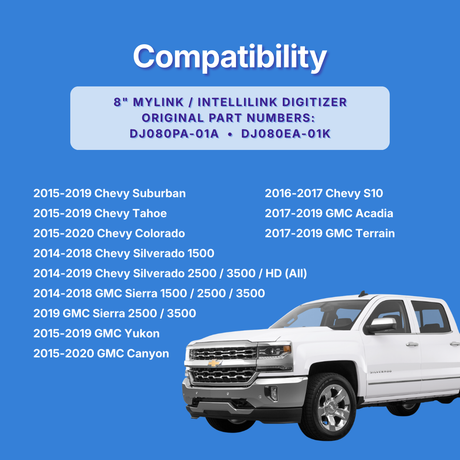
For screen assemblies that share platforms across multiple makes and models — like the DJ080PA-01A used in GM trucks and SUVs, or the UAQ/UAS platform used in Uconnect 8.4-inch systems — the LCD panel number is also useful for confirming compatibility across vehicles beyond your specific model.
What You Are Actually Looking For
Most screen assemblies have multiple numbers printed on the label. Not all of them are equally useful for ordering a replacement. Here is what each number typically represents:
- LCD panel number: Identifies the display panel itself — the glass, backlight, and LCD layers. This is usually the most directly useful number for matching a replacement. Common format examples: DJ080PA-01A, LQ080Y5DZ10, LTA080B451F.
- Assembly part number: Identifies the complete unit as installed in the vehicle, including housing, connectors, and bezel. This is the number a dealer would use to order the full OEM assembly. Format varies significantly by manufacturer.
- Serial number: Unique to the individual unit. Not useful for ordering.
- Date code: Indicates the manufacturing date of the unit. Sometimes helpful for identifying production variants. Not directly useful for ordering unless you are investigating a specific revision.
- FCC ID or regulatory identifiers: Required certifications. Not relevant for replacement ordering.
When looking for the right number to use, prioritize the LCD panel number first and the assembly part number second. If you can find both, record both before reinstalling the screen.
Method 1: The Label on the Back of the Screen
This is the most reliable method and produces the most complete information. The OEM part number, LCD panel number, date code, and serial number are all printed on a label attached to the back housing of the screen assembly. To access it, the screen needs to be at least partially removed from the dash.
The process for partial removal varies by vehicle, but the general steps are consistent across most platforms:
- Use a trim removal tool or plastic pry tool to carefully release the trim panel surrounding the screen. Most panels are held by clips and do not require removing screws.
- Once the trim is loose, the screen assembly is typically held by two to four screws at the corners. Remove these and carefully pull the screen forward enough to access the back.
- Do not disconnect any cables unless necessary. The goal is to angle the screen out far enough to photograph or read the label on the back.
- Photograph the entire label before reinstalling. The print is often small and the lighting behind a dash is poor — a photo is easier to read than trying to interpret it in place.
On most vehicles this process takes 10 to 20 minutes with basic tools. If you are already planning to replace the screen, this step is part of the installation process anyway — you will see the label when you remove the old unit.
Method 2: The Bezel Edge Peek
On some vehicles, the part number label is positioned along the top or side edge of the screen rather than flat on the back housing. This means it may be visible — with a flashlight and a phone camera — without removing the screen from the dash at all.
Aim a light source along the edge of the screen where it meets the dash trim and use your phone camera to photograph what is there. This works more reliably on vehicles where the screen sits in a shallow housing rather than recessed deep into the center stack. It is worth trying before committing to a partial removal, particularly if you are unsure whether you want to proceed with the repair yet.
Method 3: VIN Lookup Through an OEM Parts Catalog
Every vehicle has a VIN — a 17-character identifier that encodes the make, model, year, trim level, production plant, and sequence number. OEM parts catalogs use the VIN to look up the exact components that were installed in a specific vehicle, including the infotainment display assembly.
Several resources support VIN-based parts lookup:
- Dealer parts counter: Any dealer for your vehicle's brand can look up the infotainment display assembly part number by VIN. You do not need to buy anything. Ask for the part number for the radio or infotainment display and record what they give you.
- OEM online parts catalogs: GM, FCA (Stellantis), Honda/Acura, Hyundai/Kia, Subaru, and most other manufacturers have online parts catalogs that accept VIN input and return the part numbers for your specific vehicle configuration. Search for your manufacturer's official parts catalog.
- Third-party VIN decoders with parts databases: Several aftermarket parts platforms support VIN-based lookup and can return OEM part numbers for infotainment components. Quality varies — use these as a starting point for cross-referencing rather than a definitive source.
VIN lookup is particularly useful when you want to confirm a part number before removing the screen, or when the screen is so severely damaged that the label on the back is unreadable.
Method 4: The System Information Menu
Many modern infotainment systems include a system information or diagnostics screen accessible through the Settings menu. This menu typically displays software version numbers, hardware identifiers, and sometimes the display module part number.
The path to this menu varies by platform. Common locations include:
- GM MyLink / IntelliLink: Settings > About or Settings > System Information
- Uconnect (FCA / Stellantis): Settings > System Information or Settings > About
- Subaru StarLink: Settings > General > System Information
- Hyundai / Kia: Setup > General > System Info
Not all systems display the display hardware part number here — many show only software version information. But it costs nothing to check before reaching for a trim tool, and on some platforms the hardware identifier is present and useful.
Method 5: Platform Cross-Reference
If you know your vehicle's infotainment platform and model year, you can often identify the likely LCD panel number by cross-referencing against documented part numbers for that platform. This is not as definitive as reading the label directly, but it is useful for narrowing down the options and confirming a match before or after ordering.
Owner forums for specific vehicles are among the most reliable sources for platform-specific part number documentation. Owners who have completed screen repairs on the same vehicle frequently post the part numbers they used, along with notes on variants and compatibility edge cases that do not appear in any official documentation. Searching for your vehicle model plus "screen part number" or "digitizer part number" on make-specific owner forums often returns exactly this information.
Common OEM Part Numbers by Platform
The following are well-documented LCD panel part numbers for some of the most common automotive infotainment platforms. These are starting points for cross-referencing — always verify against your specific vehicle's label or VIN lookup before ordering.
| Platform | Common LCD Panel Number(s) | Vehicles |
|---|---|---|
| GM 8" MyLink / IntelliLink | DJ080PA-01A, DJ080EA-01K | Silverado, Sierra, Tahoe, Suburban, Yukon, Colorado, Canyon, Acadia (2016–2023) |
| Uconnect 4/4C 8.4" | UAQ, UAS (system codes) | Jeep Grand Cherokee, Wrangler, Cherokee, Dodge Charger, Durango, Ram 1500/2500 (2017+) |
| Uconnect 4/4C 7" | UAM (system code) | Jeep Compass, Renegade (2017–2021) |
| Cadillac CUE | Varies by generation — 8" and 10" variants | ATS, CTS, XTS, Escalade, SRX, XT5 (2013–2020) |
| Acura / Honda 7" | LQ070Y5DW04, LQ070Y5DZ10 (variants) | Acura TLX, MDX, Honda Odyssey (2014–2017) |
| Subaru StarLink 6.5" / 8" | Varies by generation and trim | Outback, Forester, Crosstrek, Legacy (2014–2019) |
| Hyundai / Kia 8" | Varies by model year and trim | Sonata, Tucson, Santa Fe, Optima, Sorento, Sportage (2017–2023) |
| Buick Encore IntelliLink | 42688395 (OEM assembly number) | Buick Encore (2017–2020) |
| Nissan / Infiniti | 25915-6CA0A (variants exist) | Altima, Sentra, Rogue, Pathfinder (2019–2022) |
Note that the same LCD panel number can sometimes be used across multiple makes and models that share an infotainment platform. The DJ080PA-01A, for example, appears in GM trucks and SUVs across both Chevrolet and GMC brands for multiple model years. Confirming this cross-compatibility can also work in the buyer's favor — a replacement sourced for one vehicle on this list will work correctly in another.
Frequently Asked Questions
Where is the OEM part number on a car infotainment screen?
The OEM part number is printed on a label on the back of the screen assembly. Accessing it typically requires partially removing the screen from the dash. On some vehicles the label is visible along the bezel edge with a flashlight and a phone camera without full removal.
Can I find my car screen's part number without removing it?
Sometimes. Check the bezel edge with a flashlight first. If that does not work, use a VIN lookup through an OEM parts catalog or ask a dealer parts counter for the display assembly part number by VIN. Both methods can return the correct part number without touching the vehicle.
What is the difference between a screen assembly part number and an LCD panel part number?
The assembly part number identifies the complete installed unit including housing and connectors. The LCD panel part number identifies the display component itself. For replacement ordering, the LCD panel part number is usually the more useful identifier and the one most commonly referenced in compatibility documentation.
Why does the OEM part number matter when ordering a replacement screen?
The same vehicle model can be equipped with different screen assemblies depending on trim level and navigation configuration. Ordering by year and model alone can result in a screen that does not fit or connect correctly. The OEM part number specifies exactly which display was installed in your vehicle and eliminates compatibility guesswork.
Does navigation vs. non-navigation affect the part number?
Yes, on many platforms. Navigation and non-navigation versions of the same screen often have different part numbers even though they look identical. Always confirm your vehicle's navigation configuration before ordering to ensure you receive the correct assembly for your system.
![[Premium] Upgraded Gel-Free Cadillac CUE Replacement Touch Screen Display-Cuescreens](http://www.cuescreens.com/cdn/shop/files/7c1892_b5fcaf040dfe42abb289e47b1fa91ab9_mv2.png?v=1738265347&width=460)


![[Premium] Upgraded Gel-Free Cadillac CUE Replacement Touch Screen Display-Cuescreens. Supports Proximity Sensors.](http://www.cuescreens.com/cdn/shop/files/7c1892_7faa9297eab444d5a99838357b9c178c_mv2.png?v=1764720901&width=460)