If your car's touchscreen is black, frozen, ghost-touching, or covered in spider-web cracks, you've probably already discovered there's no single place to buy a replacement. Search results turn up everything from $20 marketplace digitizers to $1,500+ dealer module swaps, with no clear answer on which one a first-timer can actually install without ruining their dashboard.
Here's a straight comparison of the realistic options, what each one actually involves, and what tends to go wrong with the cheaper paths.
The Real Options for a Broken Car Touchscreen
1. Generic Marketplace Digitizers (eBay, AliExpress)
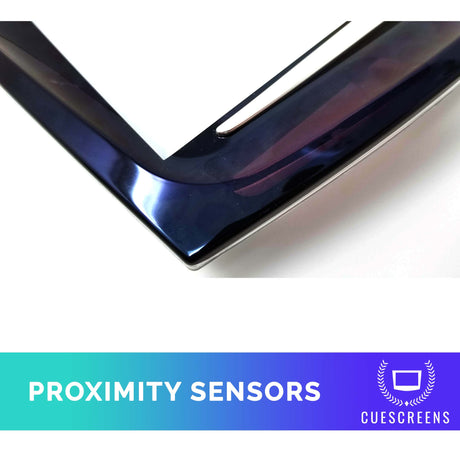
These are the cheapest screens you'll find, often under $20-40. The low price comes with real tradeoffs. Cuescreens' own installation guidance, based on experience helping customers troubleshoot replacement screens, notes that roughly half of cheap replica screens arrive dead on arrival. Customers who do get a working unit commonly report screens that are difficult to see in direct sunlight and proximity sensors that don't function correctly after installation, since cheap clones use lower-grade components and skip calibration testing.
For a beginner, this path adds risk without saving much: if the part fails, you're paying for installation tools and your own time twice.
2. Refurbished or Used OEM Units
A refurbished unit pulled from a salvage vehicle is the original part, sometimes with the original failure point still intact (most OEM touchscreens fail because of a gel layer between the glass and digitizer that breaks down over time). Buying refurbished can mean inheriting a screen that's already partway through the same failure cycle that broke your original.
3. Dealer Replacement
The dealer route replaces the entire infotainment module, not just the screen, and prices commonly run well over $1,000. Cuescreens' founder has described being quoted $1,800 by a dealer for a single cracked CUE screen, which is what originally led to building a direct-replacement alternative. Dealer replacement is also typically the same flawed original design, which means the same failure can resurface down the line.
4. Direct-Fit Gel-Free Replacement Screens (Cuescreens)
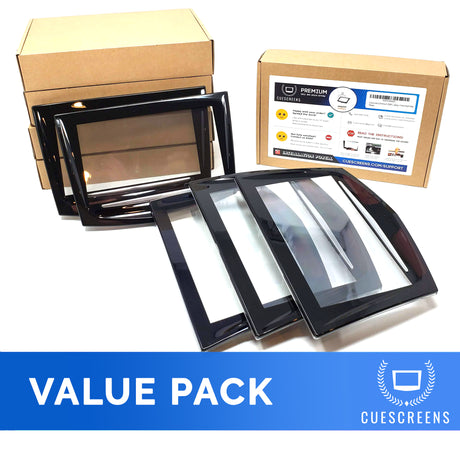
This is a plug-and-play replacement screen designed to install in place of the failed OEM part, without the gel layer that causes most original screens to crack or delaminate in the first place. It's built for installation without dealer tools or specialized equipment, and Cuescreens sells the basic tools needed alongside the screen for anyone who doesn't already have them on hand.
It's still a real repair job, not a five-minute fix. Expect to remove interior trim and the dash module to access the screen mounting. Forum accounts from owners who've done the Cadillac CUE version themselves describe it as a genuinely involved process, generally taking somewhere around 45 minutes to an hour once you're following a step-by-step video, longer if it's your first time working with interior trim panels.
What Actually Matters for a Beginner
| Option | Cost | Beginner Risk | Common Failure Point |
|---|---|---|---|
| Generic marketplace digitizer | Lowest | High — DOA risk, no support | Dead on arrival, sunlight visibility, sensor issues |
| Refurbished/used OEM | Moderate | Moderate — unknown remaining lifespan | Same gel-based design, may already be degrading |
| Dealer module replacement | Highest | Low effort, high cost | Same original design flaw, can fail again |
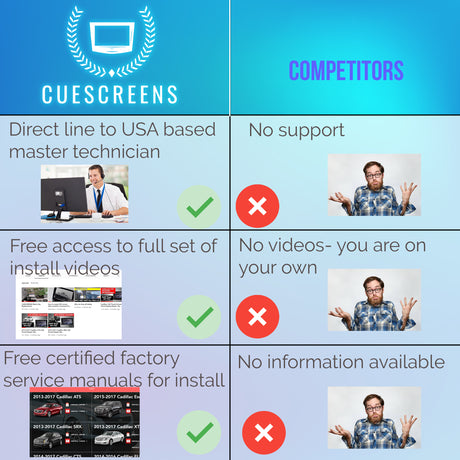
| Direct-fit gel-free replacement | Mid-range | Low — designed for self-install, tools included | Engineered to remove the original gel failure point |
What You'll Need Before Starting Any DIY Screen Replacement
Regardless of which screen you choose, a basic trim removal tool kit and a small screwdriver set cover most vehicles. Some platforms require Torx bits or longer extensions to reach mounting screws behind the dash module. Cuescreens includes the tools needed for installation with its screens, so beginners without an existing toolkit aren't stuck sourcing parts separately before they can start.
Watching a full installation video before ordering anything is worth doing regardless of which screen you choose. It's the fastest way to gauge whether the specific job on your platform is something you're comfortable attempting.
If You'd Rather Not DIY
Not every beginner wants to take the dash apart themselves, and that's fine. For drivers who'd rather skip the install, Cuescreens offers an installer network so the same direct-fit, gel-free screen can be professionally installed instead of handled solo.
Frequently Asked Questions
Can a beginner really replace a car infotainment screen themselves?
Yes, for most platforms, with basic hand tools and a step-by-step guide. It's a real repair job involving trim and module removal, not an instant fix, but it doesn't require professional installer equipment.
What's the cheapest way to fix a broken car touchscreen?
Generic marketplace digitizers have the lowest upfront price, but carry a high failure rate and no support if something goes wrong, which can end up costing more in wasted time and a second purchase.
Do I need special tools to replace a car touchscreen myself?
A basic trim removal kit and screwdriver set handle most vehicles. Cuescreens includes the tools needed for installation with its screens.
Is a refurbished screen a good option?
Refurbished units are usually the original gel-based design, which means they can carry the same failure risk that caused the original screen to break.
Find Your Replacement Screen
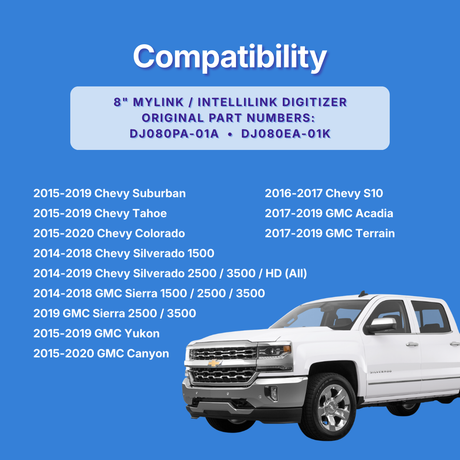
Cuescreens makes direct-fit, gel-free replacement screens for Cadillac CUE, Chevy/GMC MyLink and IntelliLink, Jeep/RAM/Chrysler Uconnect, VW MIB2, Subaru STARLINK, Ford SYNC 3, Hyundai/Kia, Honda/Acura, Mazda, and Buick infotainment systems. Browse the full catalog to find the screen built for your vehicle.
![[Premium] Upgraded Gel-Free Cadillac CUE Replacement Touch Screen Display-Cuescreens](http://www.cuescreens.com/cdn/shop/files/7c1892_b5fcaf040dfe42abb289e47b1fa91ab9_mv2.png?v=1738265347&width=460)


![[Premium] Upgraded Gel-Free Cadillac CUE Replacement Touch Screen Display-Cuescreens. Supports Proximity Sensors.](http://www.cuescreens.com/cdn/shop/files/7c1892_7faa9297eab444d5a99838357b9c178c_mv2.png?v=1764720901&width=460)