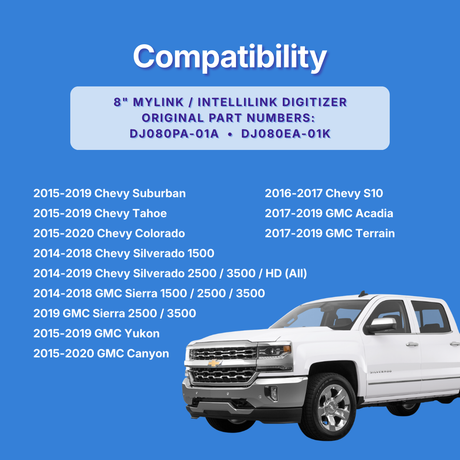
Ordering a replacement touchscreen by year and model alone is one of the most common mistakes people make. Car manufacturers often install different head units in the same vehicle depending on trim level, production run, and market region. Two 2019 Nissan Altimas sitting next to each other on a lot could have different screen sizes, different connector configurations, and different digitizer setups. The part number is what tells you which one you actually have.
Here's where to find it.
Why the Part Number Matters More Than You Think
When a replacement screen lists compatibility by year and model, that's a starting point — not a guarantee. Screen size, mounting configuration, ribbon cable type, and digitizer layer can all vary within the same model year. A screen that's close but not exact will either not fit at all or fit physically while the touch calibration is wrong. Neither outcome is acceptable after you've already pulled your dash apart.
The OEM part number removes that ambiguity. It identifies one specific unit, not a range of possibilities.
Where to Look
1. The Sticker on the Back of the Head Unit
This is the most reliable source. The head unit itself — the radio and display assembly — has a label on the back or along one of its sides. That label includes the part number, usually alongside a barcode and manufacturing data. The format varies by manufacturer, but the part number is typically the longest alphanumeric string on the label.
To get to it, the unit needs to come out of the dash. That means removing whatever trim panels surround it and disconnecting it from the vehicle. It doesn't need to be fully disconnected — just pulled out far enough to read the label. If you're going to replace the screen anyway, this is a natural first step.
2. The Infotainment System's Settings Menu
Before pulling anything out, check the screen itself. Many vehicles have a Settings or About menu in the infotainment system that displays unit information, including firmware version, software build, or hardware identifiers. This varies widely by make and model, but it's worth checking first — it takes 30 seconds and requires no tools.
Common paths to look for: Settings > System > About, or Settings > General > System Information. Some GM vehicles display this information in a diagnostic mode accessible through specific button sequences.
3. Your Vehicle's VIN
Your VIN — the 17-character number on your dashboard, door jamb, and registration — encodes the factory-installed equipment on your specific vehicle. A dealer parts department can use your VIN to pull up the exact head unit installed at the factory and identify the correct part number from there. Some online VIN decoders offer similar functionality, though dealer-level data is more reliable for confirming infotainment specifics.
This is a useful approach when the unit has already been removed or replaced and the original label is gone.
4. Stickers Inside the Glove Box or Door Jamb
Some manufacturers include equipment codes or option codes on stickers placed inside the glove box, door jamb, or trunk. These codes identify factory-installed features and packages, which can be cross-referenced to determine the specific infotainment unit. This method requires a bit more legwork — you'll typically need to look up what the option codes mean for your specific make — but it can save you a trip to the dealer.
5. The Owner's Manual or Build Sheet
If you have your vehicle's original window sticker or build sheet, the infotainment system will be listed under installed options. That description, combined with your trim level, is often enough to narrow down the correct part number when cross-referenced against a parts catalog.
What the Part Number Looks Like
OEM part numbers vary by manufacturer. A few examples of the format you're looking for:
- Nissan: 259156CA0A
- GM/Cadillac: typically an 8-digit number (e.g., 23234941)
- Chrysler/Jeep/RAM: alphanumeric strings often beginning with a letter (e.g., 68374992AC)
The exact formatting doesn't matter as much as finding the complete string. Partial numbers or guesses based on similar-looking units are not reliable.
When You Can't Find It
If you've checked the unit, the settings menu, and the VIN data and still can't pin down the part number, don't guess. Contact Cuescreens with your year, make, model, and trim level. A photo of your existing screen — including any visible labels — is helpful. The support team can help confirm the correct part before you order.
Ordering the wrong screen is an avoidable mistake. A few extra minutes of verification upfront saves the time and cost of a return.
Frequently Asked Questions
Where is the part number on a car touchscreen?
The part number is usually printed on a sticker on the back or side of the head unit. To access it, the unit typically needs to be pulled out of the dash. It may also appear in the infotainment system's settings menu or on a sticker inside the glove box or door jamb.
Can I find my car screen part number without removing the unit?
Sometimes. Some vehicles display unit information through the infotainment system's Settings or About menu. Your VIN, interpreted through a dealer or VIN decoder, can also identify the factory-installed unit without requiring you to touch the dash.
Why does the part number matter when replacing a car touchscreen?
Manufacturers often install different head units in the same model year depending on trim level and production date. Two vehicles that look identical can have different screen sizes, connector types, and digitizer configurations. The part number is the only way to guarantee the correct fit.
What if I can't find the part number on my unit?
Contact Cuescreens with your year, make, model, trim level, and a photo of your screen if possible. The support team can help verify the correct part number before you order.
![[Premium] Upgraded Gel-Free Cadillac CUE Replacement Touch Screen Display-Cuescreens](http://www.cuescreens.com/cdn/shop/files/7c1892_b5fcaf040dfe42abb289e47b1fa91ab9_mv2.png?v=1738265347&width=460)


![[Premium] Upgraded Gel-Free Cadillac CUE Replacement Touch Screen Display-Cuescreens. Supports Proximity Sensors.](http://www.cuescreens.com/cdn/shop/files/7c1892_7faa9297eab444d5a99838357b9c178c_mv2.png?v=1764720901&width=460)