What Each Component Actually Does
The screen is the LCD and touch digitizer assembly. It's the physical glass and display you look at and touch. On its own, it has no intelligence. It displays whatever image it's sent and reports back wherever you touch it.
The head unit is the computer behind the dash. It runs the actual software, processes Bluetooth and navigation, controls audio routing, and talks to the rest of the vehicle's electronics over the car's data network. The head unit sends the image to the screen and receives touch input back from it through a cable, usually a ribbon or flex connector.
These two components can fail completely independently of each other. A perfectly healthy head unit can be connected to a screen with a degraded LCD or a failing digitizer. A perfectly healthy screen can be connected to a head unit that has a corrupted software image or a failed internal component. The trick is figuring out which side of that cable the problem is actually on.
Signals That Point to the Screen
These patterns mean the screen assembly, not the head unit, is the likely cause:
- Touch works but in the wrong place, or doesn't work at all, while the image is fine. This is digitizer failure. The display is rendering correctly, which means the head unit is doing its job. The touch layer reading your finger position incorrectly is a separate, physical problem.
- Ghost touch. The screen presses buttons or changes menus on its own. This is one of the clearest digitizer symptoms there is. The head unit isn't generating phantom commands, the touch layer is sending bad input.
- Bubbling, haze, or a spiderweb pattern under the glass. This is visible physical delamination of the screen assembly. It has nothing to do with the head unit.
- Lines, dark spots, or distorted color, while audio and touch otherwise function. This points to the LCD panel itself degrading, still a screen-side issue, not the computer behind it.
- Black screen, but audio, Bluetooth, and steering wheel controls work normally. If the head unit is clearly still running everything else, the failure is isolated to the display, its backlight, or the cable connecting it. Replacing the head unit in this case replaces a component that was never broken.
- Symptoms that get worse in heat and improve when the cabin cools down. Heat-related degradation almost always points to the adhesive layer or LCD panel inside the screen assembly, not the head unit's internal electronics.
Signals That Point to the Head Unit
Be honest with yourself about these. A screen replacement will not fix any of them:
- Total system failure. No audio, no display, no response to any control, touch or physical. This points to the head unit, a power/fuse fault, or a wiring problem, not the screen.
- The system boots, then crashes or reboots in a loop, regardless of touch input. A boot loop is a software or internal hardware fault inside the head unit itself.
- Bluetooth, navigation, or backup camera fail along with the display, but audio still plays through speakers. When multiple independent functions degrade together, that points to the central module rather than the screen.
- The unit shows a "locked" or theft-protection message after a battery disconnect or used-parts swap. This is a head unit/VIN-lock issue on platforms with anti-theft pairing, unrelated to the screen.
- Diagnostic trouble codes related to the infotainment module, MOST bus, or communication network. If a shop pulls codes pointing to module communication failure, that's a head unit or network-level issue, not a display problem.
The Two-Minute Check
If you only do one thing before deciding which part you need, do this: try to control the system using something other than the touchscreen. Steering wheel buttons, physical knobs, voice commands, or hard buttons around the screen.
| What happens | What it usually means |
|---|---|
| Non-touch controls still work, audio still plays, only the screen itself is unresponsive or visually broken | Screen assembly issue. Head unit is functioning. |
| Nothing responds at all, no audio, no buttons, no screen | Head unit, power, or wiring issue. Needs further diagnosis before buying parts. |
| Screen looks normal but touch is wrong or absent | Digitizer failure. Screen assembly issue. |
| Screen is black, but you can still hear audio and use voice/steering controls | Display, backlight, or connector issue. Screen assembly, not head unit. |
For a more detailed walkthrough with additional tests, including fuse checks and soft resets, see our full 7-test diagnostic guide.
Where This Gets Genuinely Hard to Call
Being straightforward here: not every failure sorts cleanly into one category. Intermittent freezing, partial system reboots, or symptoms that come and go without a clear pattern can be caused by either component, or by the connection between them. A degraded ribbon cable, for example, can produce symptoms that look like both a screen problem and a head unit problem depending on how it's flexed at any given moment.
In these ambiguous cases, the honest answer is that a confident diagnosis usually requires one of the following:
- A known-good replacement screen temporarily connected to test whether the head unit drives it correctly
- A shop pulling diagnostic trouble codes from the vehicle's network
- A technician checking voltage and continuity at the connector itself
If your symptoms don't match clearly onto either list above, it's worth getting an actual diagnosis rather than guessing and buying a part that may not solve the problem.
Why This Distinction Matters for Cost
The price gap between these two repairs is significant. A direct-fit replacement screen assembly typically runs well under $300 in parts, and Cuescreens' replacements are designed to install with basic tools and no programming. A head unit replacement, by contrast, frequently requires VIN programming or dealer activation and can run well over $1,000 once parts, programming, and labor are included.
This is also why it's worth being skeptical of a quick "you need a whole new unit" diagnosis. Replacing the entire head unit is faster for a shop to quote and sell, even when the actual failure is isolated to the screen. If your symptoms point clearly to the screen using the list above, there's rarely a reason to pay for a full head unit replacement.
If It Is the Screen
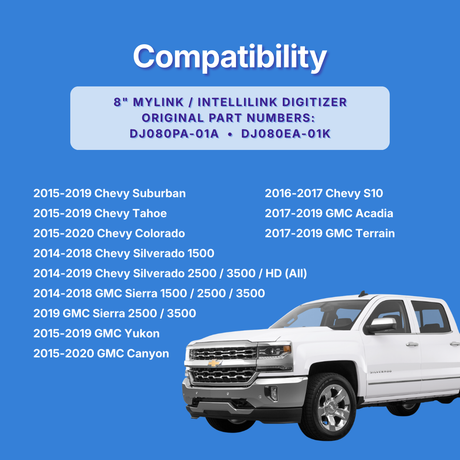
Cuescreens makes direct-fit, gel-free LCD and touchscreen replacements across multiple platforms, including Uconnect 4/4C 8.4", Chevy/GMC MyLink/IntelliLink, and Cadillac CUE. None of these require head unit replacement or dealer programming. Browse the full catalog to find your specific system.
If It Is the Head Unit
Cuescreens sells screens, not head units, so we'll say this plainly: if your symptoms point to the head unit itself, a screen replacement is not the right fix and we'd rather tell you that now than sell you a part that won't solve your problem. A dealer, independent infotainment specialist, or qualified shop is the right next step for head unit diagnosis and replacement.
Frequently Asked Questions
What's the difference between the screen and the head unit?
The screen is the LCD and touch digitizer you look at and touch. The head unit is the computer module behind it that processes everything and sends the image to the screen. They're separate parts connected by a cable, and either can fail on its own.
If my screen is black but I can still hear the radio, is it the screen or the head unit?
If audio, Bluetooth, and steering wheel controls still work, the head unit is functioning. A black screen with everything else working points to the display, backlight, or connector.
If the whole system is dead, is that the head unit?
A complete loss of audio, display, and controls together points to the head unit, a power/fuse issue, or wiring, not the screen alone. This is the one pattern a screen replacement won't fix.
Can a bad screen damage the head unit?
Usually no. The two are electrically isolated enough that a failed digitizer or LCD typically doesn't harm the head unit, though a shorted cable on some platforms is an exception worth inspecting for.
Is it ever impossible to tell without a shop?
Yes. Intermittent or partial failures can come from either component or the connection between them. In those cases, a test screen, diagnostic codes, or a technician's voltage check is the only reliable answer.
Cuescreens makes gel-free, direct-fit replacement screens for Cadillac CUE, GM/Chevy MyLink, Uconnect, VW MIB2, Ford Sync 3, and more. Find your vehicle's screen or run through our full diagnostic test guide before you order.
![[Premium] Upgraded Gel-Free Cadillac CUE Replacement Touch Screen Display-Cuescreens](http://www.cuescreens.com/cdn/shop/files/7c1892_b5fcaf040dfe42abb289e47b1fa91ab9_mv2.png?v=1738265347&width=460)


![[Premium] Upgraded Gel-Free Cadillac CUE Replacement Touch Screen Display-Cuescreens. Supports Proximity Sensors.](http://www.cuescreens.com/cdn/shop/files/7c1892_7faa9297eab444d5a99838357b9c178c_mv2.png?v=1764720901&width=460)