Most advice about low-quality replacement touchscreens focuses on the listing itself: stock photos, vague compatibility claims, seller history. That is worth checking, and we covered it in how to spot a counterfeit replacement touchscreen before you buy. What that guide does not cover is what happens once the part is already in the dash.
The Problems Show Up After Installation, Not Before
A cheap screen rarely fails on arrival. It usually looks fine out of the box, passes a quick bench test, and gets installed without issue. The problems tend to surface later:
- Edge or bottom-of-screen dead zones. A section of the touch surface stops responding, often starting at one edge and spreading over time. This points to inconsistent bonding or a lower-grade digitizer film.
- Ghost touch. The screen registers taps or swipes on its own, changing menus or settings without anyone touching it.
- Delamination or bubbling. Air pockets or separation appear between the screen layers, usually worse in heat or direct sunlight.
- Washed-out or dim display. The screen becomes hard to read outdoors, a sign of a lower-quality backlight or panel.
None of these show up in a five-minute test after install. They show up weeks or months later, after the return window on many marketplace listings has already closed.
Why Refunds Get Complicated Once a Screen Is Installed
This is the part that generates the most frustration. Once a screen is installed, some sellers treat that as evidence the failure was caused by installation error rather than the part itself, regardless of whether that is actually true. Combine that with a seller who has no fixed return window, no dedicated support line, and no way to verify the account is even still active, and a legitimate defect claim can turn into weeks of unanswered messages.
This is not a universal problem with every low-cost seller, but it is common enough that it is worth planning for before you buy, not after a screen has already failed.
What a Genuine Replacement Screen Should Offer
The difference between a genuine, well-made replacement and a low-cost copy usually comes down to a few things you can check before you buy:
- Direct-fit, not universal. A listing for your exact model and year, not a generic "fits most vehicles" description.
- Gel-free bonding. Gel-based bonding is more prone to bubbling and delamination over time compared to a gel-free construction.
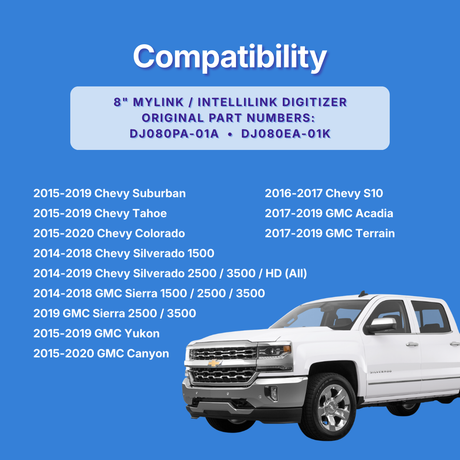
- A stated part number. One you can cross-reference against your vehicle, not just a product photo.
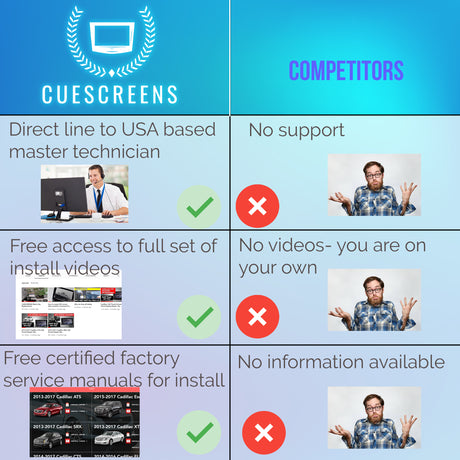
- A warranty and return policy stated up front. Not something you have to ask about after a problem shows up. Cuescreens' current return terms are posted on our refund policy page, and warranty support requests can be submitted through our warranty request form.
- Real support behind it. A phone number and email tied to an actual business, not a marketplace account with no other way to reach anyone.
Buy From a Source You Can Actually Reach Later
The cheapest listing and the least risky listing are rarely the same one. Before you buy, it is worth asking: if this part fails three months from now, is there anyone to call? You can browse Cuescreens' full lineup of direct-fit, gel-free touchscreen and digitizer replacements by vehicle at our full catalog, or reach our support team directly through our support page with questions before you order.
Frequently Asked Questions
What are the most common failures with cheap replacement touchscreens after installation?
The most commonly reported issues are edge or bottom-of-screen dead zones, ghost touch, delamination or bubbling between layers, and dim or washed-out displays in direct sunlight. These issues often show up weeks or months after installation, not immediately.
Why is it harder to get a refund after a cheap screen has already been installed?
Once a screen has been installed, many low-cost sellers treat that as proof the issue was caused by the installation rather than the part itself, even when the defect is unrelated to how it was installed. Sellers with no fixed return window or no dedicated support process can also become difficult to reach once a sale is complete.
What should I check before buying a replacement touchscreen to avoid these problems?
Confirm the listing states a specific part number for your exact model and year, not a generic or universal fit claim. Check that a warranty or return policy is stated clearly before you buy, not just implied. Look for a seller with a real support channel, such as a phone number or email tied to a business, rather than a marketplace-only account.
About the Author: Daniel Gigante has over 18 years of experience in the automotive industry, with a focus on vehicle technology, infotainment systems, and real-world reliability. He writes about automotive design, touchscreen usability, and how modern technology impacts everyday driving.
![[Premium] Upgraded Gel-Free Cadillac CUE Replacement Touch Screen Display-Cuescreens](http://www.cuescreens.com/cdn/shop/files/7c1892_b5fcaf040dfe42abb289e47b1fa91ab9_mv2.png?v=1738265347&width=460)


![[Premium] Upgraded Gel-Free Cadillac CUE Replacement Touch Screen Display-Cuescreens. Supports Proximity Sensors.](http://www.cuescreens.com/cdn/shop/files/7c1892_7faa9297eab444d5a99838357b9c178c_mv2.png?v=1764720901&width=460)