A head unit is the electronic module behind your dashboard that runs your car's audio and infotainment system. It's the processor, the memory, and the software, all packaged into a sealed unit mounted in the center console. The touchscreen sitting on top of it is a separate component entirely, and that distinction is the single most important thing to understand before you decide how to fix a broken screen.
What the Head Unit Actually Does
The head unit handles radio, Bluetooth, USB and media playback, navigation processing, and on many platforms, smartphone integration through Apple CarPlay or Android Auto. It's the brain of the system. Whether your screen displays correctly or responds to touch at all has nothing to do with whether this processor is working, since the head unit can be functioning perfectly while the display layer in front of it has failed.
Why People Confuse the Two
From the driver's seat, the screen is the only part of the system you ever touch or look at, so it's natural to think of "the screen" and "the head unit" as the same thing. They're not. The screen assembly you interact with is made up of a few distinct layers: an LCD panel that produces the image, and a digitizer on top of it that registers your touch input. Both of those sit in front of the head unit, connected to it by a wiring harness or ribbon cable, but physically and electronically separate from it.
This matters because a failure in any one of these three components, the head unit, the LCD, or the digitizer, looks similar from the driver's seat. Your screen might go black, freeze, or stop responding to touch. But what's actually broken determines what kind of repair you need, and the cost difference between those repairs is significant.
Why This Distinction Determines Your Repair Cost
Dealership service procedures are generally built around swapping the entire sealed module when there's a screen problem, not opening it up to replace a single internal layer. That means a digitizer that's simply lost touch sensitivity often gets diagnosed and billed as a full head unit replacement, even though the processor inside was never the problem.
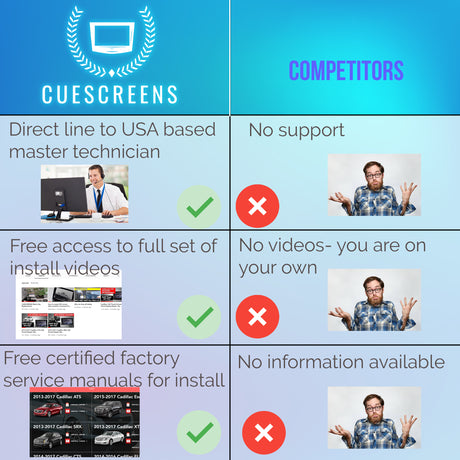
This is the core reason screen-only repairs through a supplier like Cuescreens can cost a fraction of a dealership head unit swap. You're replacing the part that actually failed, the touchscreen, not the computer behind it that was working fine the whole time.
Why Head Unit Replacement Often Requires Programming, and Screen Replacement Usually Doesn't
This is where the distinction has real practical consequences. On many GM vehicles, the infotainment module, whether it's called an HMI or a CSM depending on the platform, is VIN-locked. A new or used module won't function until it's programmed to your specific vehicle's VIN through GM's Service Programming System, which typically requires a dealer or specialized programming service. Skip that step and the screen will show a theft lock message and stay non-functional.
A straightforward screen or digitizer replacement doesn't touch any of that. You're not swapping the VIN-locked computer, only the display and touch layer mounted in front of it, so there's no programming step involved on most platforms. Volkswagen vehicles with Component Protection follow a similar logic: it's the head unit that's tied to the vehicle's security system, not the screen attached to it.
How to Tell Which Part Actually Failed
A few quick checks point you toward the right diagnosis:
- If the screen still shows a clear image but touch input doesn't register, or registers in the wrong spot, the digitizer is the likely cause, not the head unit
- If the screen is completely black but you can still hear audio, use steering wheel controls, or hear the backup camera chime when you shift into reverse, the head unit is likely still functioning and the problem is isolated to the display
- If audio, Bluetooth, and every other function have also stopped working at the same time, that points toward the head unit itself, not just the screen
Quick Answer
A head unit is the computer behind your dashboard. The touchscreen and digitizer are separate components mounted in front of it. Most screen-only problems don't require touching the head unit at all, which means no VIN programming and a much lower repair cost than a full head unit swap, as long as you correctly identify which part actually failed before you start.
![[Premium] Upgraded Gel-Free Cadillac CUE Replacement Touch Screen Display-Cuescreens](http://www.cuescreens.com/cdn/shop/files/7c1892_b5fcaf040dfe42abb289e47b1fa91ab9_mv2.png?v=1738265347&width=460)


![[Premium] Upgraded Gel-Free Cadillac CUE Replacement Touch Screen Display-Cuescreens. Supports Proximity Sensors.](http://www.cuescreens.com/cdn/shop/files/7c1892_7faa9297eab444d5a99838357b9c178c_mv2.png?v=1764720901&width=460)