If your Cadillac CUE is frozen on the "Warning: Do not take your eyes off the road" message and won't let you tap past it, a hard reset is usually the first thing anyone tells you to try. Sometimes it works. Sometimes the screen clears for a few seconds, shows your profile page, then snaps right back to the same warning. And sometimes nothing happens at all. Here's why that reset doesn't always do the job, and how to tell what you're actually dealing with.
What a Hard Reset Is Actually Fixing
The CUE system stays powered even when your vehicle is off, so the backup camera and other features can load instantly. Because it rarely fully shuts down, small software lockups can build up over time, the same way an old phone gets sluggish until you restart it. A hard reset forces that full power cycle and clears those lockups.
The steps are simple:
- Turn the ignition on, engine off.
- Open the CUE faceplate to expose the storage compartment behind it.
- With the faceplate still open, turn the vehicle off.
- Open the driver's side door.
- Wait 30 to 60 seconds with the door open.
- Close the door and start the vehicle.
- Lower the faceplate and try the touchscreen again.
This works well when the warning screen is stuck because of a software glitch. That's exactly the kind of problem a reset is designed to clear.
Why It Doesn't Work Every Time
The eyes-on-the-road warning page is built to require a tap before you can continue. It's a confirmation gate, not a passive message. If your touchscreen digitizer has actually failed, whether from cracking, bubbling, or the gel-based bonding layer breaking down inside the factory screen, the system isn't glitching. It genuinely cannot register your tap. A hard reset restarts the software, but it can't restore a physical component that no longer senses touch.
That's the real difference. A software lockup is temporary and a reset clears it. A failed digitizer is a hardware problem, and no amount of resetting changes that.
How to Tell Which One You Have
A few signs point toward a hardware issue rather than a software one:
- The warning screen clears briefly after a reset, then returns within seconds.
- Touch doesn't register anywhere else on the screen either, not just on the warning page.
- You've noticed ghost touches, ignored taps, or a cracked or cloudy look to the screen before this started.
- You've already tried more than one reset with no change at all.
If any of that sounds familiar, the reset was never going to solve it. The fix is replacing the touchscreen itself.
What a Screen Replacement Does and Doesn't Fix
Worth being clear about this before you order anything. A replacement touchscreen resolves cracking, bubbling, delamination, and unresponsive or erratic touch behavior, including the kind that locks you on the warning page. It does not fix a completely black screen, blacked out AC controls, or firmware related errors. Those point to a separate issue, and a screen swap by itself won't touch them.
Replacing the Screen Isn't a Five Minute Job
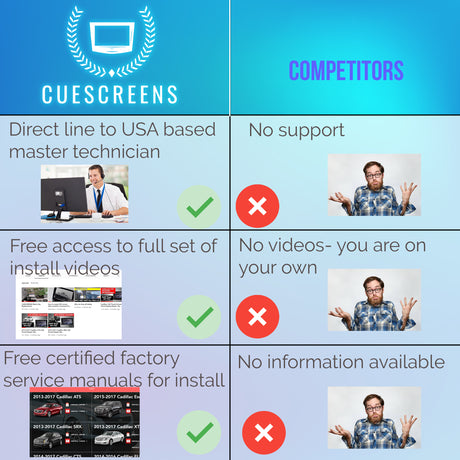
It's worth setting expectations here too. Replacing the CUE touchscreen means pulling the center stack module out of the dash, disconnecting it, and working on the digitizer itself before reinstalling everything. It's a real repair with real steps involved, not something you knock out on a lunch break. Cuescreens ships a step by step installation guide and video walkthroughs with every order for anyone doing it themselves, and there's a nationwide network of independent installers if you'd rather have someone else handle it.
For comparison, a full CUE infotainment module replacement at the dealer can run close to $2,000. Cuescreens' Premium Gel-Free Cadillac CUE Touchscreen Replacement covers 2013 through 2020 CUE systems, including ATS, CTS, SRX, XTS, and Escalade models, with a dual-mode chip built to work across that entire range.
The Bottom Line
If a hard reset clears your CUE warning screen and it stays gone, the problem was software and you're done. If it keeps coming back, or the screen doesn't respond to a reset at all, you're looking at a failed digitizer, and the only real fix is a new screen.
About the Author: Daniel Gigante has over 18 years of experience in the automotive industry, with a focus on vehicle technology, infotainment systems, and real-world reliability. He writes about automotive design, touchscreen usability, and how modern technology impacts everyday driving.
![[Premium] Upgraded Gel-Free Cadillac CUE Replacement Touch Screen Display-Cuescreens](http://www.cuescreens.com/cdn/shop/files/7c1892_b5fcaf040dfe42abb289e47b1fa91ab9_mv2.png?v=1738265347&width=460)


![[Premium] Upgraded Gel-Free Cadillac CUE Replacement Touch Screen Display-Cuescreens. Supports Proximity Sensors.](http://www.cuescreens.com/cdn/shop/files/7c1892_7faa9297eab444d5a99838357b9c178c_mv2.png?v=1764720901&width=460)