If your car’s touchscreen is glitching, ghost-touching, cracked, or completely unresponsive, you might expect a simple fix: replace the screen. Instead, the dealership comes back with a $1,800–$3,500 quote to replace the entire radio module.
At Cuescreens, we talk to customers every day who are shocked to learn that dealerships almost never replace just the screen—even when the screen is clearly the only failed component. Let’s break down why this happens, what’s really going on inside your dash, and how you can avoid paying thousands more than necessary.
First: The Screen Is Not the Whole Radio
Modern infotainment systems are made up of multiple components:
- LCD display (what you see)
- Digitizer (what senses your touch)
- Radio control module (the “brain”)
- Vehicle integration systems (backup camera, HVAC, CarPlay, etc.)
In most failure cases—especially ghost touch, dead spots, bubbling, or random button presses—the digitizer layer fails, not the radio module.
If you’re not sure what’s actually happening inside your screen, read: Ghost Touch vs Digitizer Failure: What’s Actually Happening Inside Your Car’s Screen.
Replacing the entire radio when only the digitizer is bad is like replacing your entire laptop because the touchscreen stopped working.
Why Dealerships Replace the Whole Unit
There are four main reasons dealerships default to full radio replacement.
1) Manufacturers Don’t Sell the Screen Separately
OEMs (Original Equipment Manufacturers) typically supply infotainment systems as sealed assemblies. That means:
- No individual digitizer part number
- No separate LCD listing
- No dealership-level repair option
From the dealer’s perspective, the only “approved” repair is full replacement.
2) Dealership Technicians Aren’t Trained for Component-Level Repairs
Dealership service departments are built for module swaps, factory diagnostics, and warranty work. They are not set up to disassemble bonded screens and replace digitizers.
Component-level repair requires:
- Precision separation tools
- Adhesive removal
- Proper re-bonding
- Dust-free handling
It’s specialized work—and it’s not part of standard dealership workflow.
3) Warranty & Liability Policies
If a dealership opens your radio and replaces just the screen, they assume liability for future issues, it can void the OEM part warranty, and it adds documentation complexity.
So instead, they install a brand-new OEM unit and warranty that entire module. It’s cleaner for them—and more expensive for you.
4) Programming & VIN Coding Revenue
Full radio replacements often require VIN programming, software flashing, and dealer calibration—adding billable labor hours. Replacing only the screen usually does not require reprogramming.
The Real Cost Difference
Here’s what we typically see:
| Repair Option | Typical Cost |
|---|---|
| Dealership Full Radio Replacement | $1,800 – $3,500+ |
| Screen / Digitizer Replacement Only | $300 – $700 |
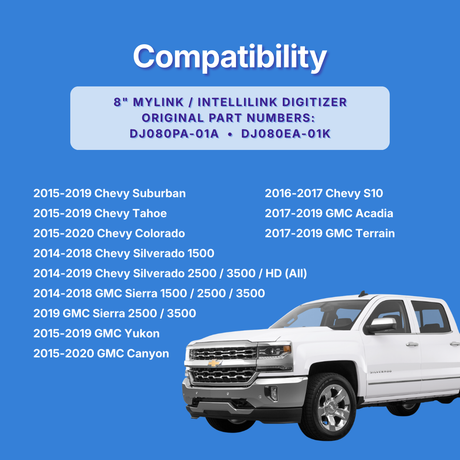
For common systems like GMC IntelliLink, Ford SYNC 2, Chevy MyLink, and Mazda Connect, the failure is overwhelmingly screen-related—not module-related.
If you own a GMC, this guide explains it in detail: GMC Sierra IntelliLink Screen Failure: Symptoms and the Permanent Fix.
When Is Full Replacement Necessary?
To be fair, there are situations where the entire unit must be replaced:
- No power to the radio at all
- Internal motherboard failure
- Audio output failure
- Software corruption that won’t reflash
- Water damage to internal boards
But these are far less common than digitizer failures. If your system still plays music and still shows video, but presses buttons by itself, it’s almost always the digitizer.
If you're unsure, read: Is Your Car Screen Actually Broken? 7 Tests to Diagnose Before You Replace It.
Why Screens Fail in the First Place
Most touchscreen failures happen because of:
- Heat expansion and UV damage
- Adhesive breakdown
- Moisture intrusion
- Pressure stress over time
Why Cuescreens Does It Differently
At Cuescreens, we focus specifically on:
- OEM-quality replacement digitizers
- Direct-fit solutions
- Permanent ghost-touch fixes
- DIY-friendly installs
You don’t need VIN reprogramming, dealer calibration, or full module replacement—just the part that actually failed.
Why Dealerships Aren’t “Wrong”—Just Limited
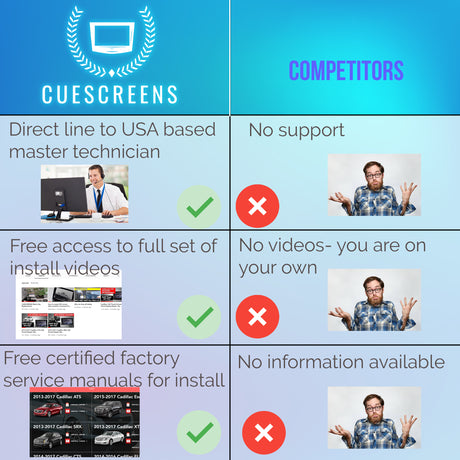
Dealerships aren’t trying to scam you. They’re constrained by manufacturer policies, service procedures, and parts supply chains. Their repair model is “replace and warranty.” Ours is “repair what actually failed.”
![[Premium] Upgraded Gel-Free Cadillac CUE Replacement Touch Screen Display-Cuescreens](http://www.cuescreens.com/cdn/shop/files/7c1892_b5fcaf040dfe42abb289e47b1fa91ab9_mv2.png?v=1738265347&width=460)


![[Premium] Upgraded Gel-Free Cadillac CUE Replacement Touch Screen Display-Cuescreens. Supports Proximity Sensors.](http://www.cuescreens.com/cdn/shop/files/7c1892_7faa9297eab444d5a99838357b9c178c_mv2.png?v=1764720901&width=460)