Not all car touchscreens are built the same way. Some platforms hold up for the life of the vehicle with minimal issues. Others start failing within five years — ghost touching, unresponsive zones, delamination, or a screen that just goes dark one day. If you own one of the vehicles on the more problematic end of that spectrum, you've probably already experienced it firsthand.
The reasons some vehicles are more prone to screen failure than others come down to a handful of engineering decisions made at the factory level. Understanding those decisions helps explain why certain platforms show up in repair forums constantly while others rarely come up at all.
How Car Touchscreens Are Built
A factory infotainment screen is not a single component. It's an assembly that typically includes a display panel, a digitizer (the touch-sensing layer), a bezel, and internal wiring that connects everything to the vehicle's infotainment module. The way these layers are bonded together — and the quality of the components used — has a direct impact on long-term reliability.
There are two primary bonding methods used in automotive screens:
- Air-bonded displays have a small air gap between the digitizer and the display panel. They're easier to manufacture and repair, but the gap can allow dust and moisture to accumulate over time.
- Gel-bonded (optically bonded) displays use a transparent adhesive layer to bond the digitizer directly to the display. This method improves optical clarity and durability when the adhesive holds — but when it degrades, it causes delamination, bubbling, and touch failure that can't be repaired. The entire assembly has to be replaced.
Several of the most failure-prone platforms on the market use gel bonding, and the adhesive used in earlier production years did not hold up well over time, particularly in vehicles that see significant heat exposure.
The Biggest Factors Behind Screen Failure
Heat and Sun Exposure
Automotive touchscreens are mounted in dashboards that can reach extreme temperatures — especially in warmer climates or vehicles that sit in direct sunlight regularly. Heat accelerates adhesive breakdown in gel-bonded screens, degrades the digitizer's sensitivity over time, and stresses internal components. Screens mounted at a steep angle facing the sun take more abuse than those positioned at a lower angle or set back from the windshield.
Digitizer Quality
The digitizer is the layer that actually reads your touch input. When it fails, the screen may respond to touches you're not making (ghost touching), stop responding in certain zones, or go completely unresponsive. Digitizer quality varied significantly across OEM suppliers during the production years of many high-failure platforms. This is why the same model can have widely different reliability depending on the production year.
Software Load on the Infotainment System
Some infotainment platforms push hardware harder than others. Systems that run complex navigation, rear camera processing, climate control, audio DSP, and app connectivity all from the same processor generate more heat internally and put more strain on the display components. Platforms that were designed with tight hardware budgets and then had software features added over time through OEM updates tend to show more reliability issues as they age.
Mounting Position and Vibration
Screens that are mounted in high-vibration areas, or that were installed with poor retention in the dash, can develop connector issues and internal damage over time. This is less of a factor than heat and digitizer quality, but it contributes in certain platforms.
Which Platforms See the Most Problems
Cadillac CUE (2013-2019)
The Cadillac CUE system is one of the most widely reported for screen failure. Ghost touching — where the screen registers phantom inputs and behaves erratically — became a known issue across the 2013-2019 generation. The haptic touch design used in early CUE screens was particularly sensitive to digitizer degradation. Cadillac extended the warranty on some affected vehicles, but the fix for most owners outside the warranty window is a full screen replacement.
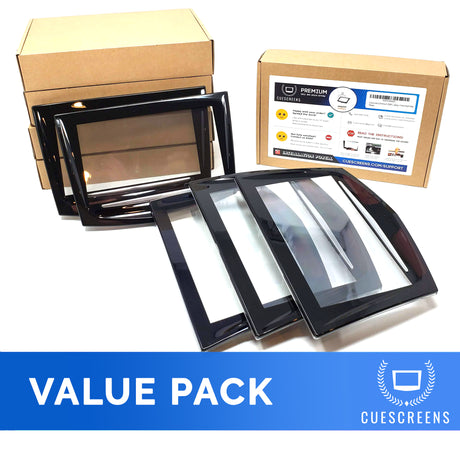
The CUE replacement is not a simple job. It involves removing trim panels and working carefully around clips and connectors, and it's a multi-step procedure that requires the right tools. Cuescreens sells a direct replacement CUE assembly that is compatible with the original harness — view Cadillac CUE replacement screens here.
GM MyLink (2014-2019 Chevrolet and GMC)
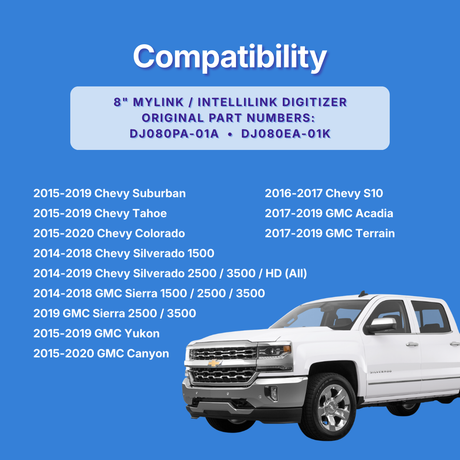
The MyLink platform across Silverado, Colorado, Equinox, Traverse, and other GM vehicles from this era developed a reputation for touchscreens that become unresponsive or stop registering input in specific zones. The failure pattern is often gradual — starting with slower response times before progressing to full zones becoming dead. Heat is a major contributor, particularly in trucks that see a lot of sun exposure.
Cuescreens carries replacement MyLink assemblies for this generation — view GM MyLink replacement screens here.
Uconnect 4 (Jeep, RAM, Chrysler, Dodge)
The Uconnect 4 platform, used across a wide range of FCA vehicles through the late 2010s and into the early 2020s, developed issues with screen delamination and touch response. The combination of gel bonding and the thermal environment in certain trim levels created conditions for adhesive failure over time. Jeep Wrangler and Gladiator owners are among the most vocal about this, given the off-road and outdoor exposure those vehicles see.
Cuescreens sells Uconnect replacement assemblies compatible with Jeep, RAM, Chrysler, and Dodge applications — view Uconnect replacement screens here.
Why Dealer Repairs Are Expensive
When a factory screen fails, the dealer typically replaces the entire infotainment assembly rather than just the screen component. Labor time is significant, and OEM part costs are high. Depending on the platform and vehicle, dealer screen replacements commonly run between $500 and $1,500 or more. For out-of-warranty vehicles, that cost falls entirely on the owner.
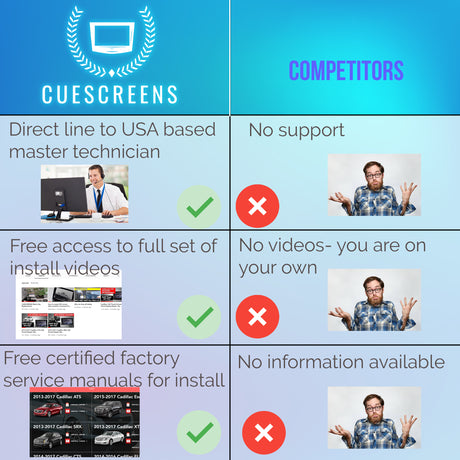
The alternative is a direct replacement screen assembly from a specialist. Cuescreens sells OEM-quality replacement assemblies that are plug-and-play compatible with the original harness — no programming, no dealer visit. Every Cuescreens replacement comes with a 3-year warranty, which is longer than the typical dealer parts warranty on a comparable repair.
What to Do If Your Screen Is Failing
If your screen is showing early signs of failure — slow response, unresponsive zones, ghost touching, or visible delamination — the options are:
- Dealer repair: Full assembly replacement, highest cost, typically uses OEM parts
- Third-party repair shop: Variable quality, often sources aftermarket components
- DIY screen replacement: Direct replacement assembly, plug-and-play, no programming required
For most owners who are comfortable with basic trim removal and following step-by-step instructions, a direct replacement is the most cost-effective path. Cuescreens assemblies are gel-free, which eliminates the adhesive degradation problem that caused the failure in the first place.
Browse replacement screens by vehicle at cuescreens.com.
Frequently Asked Questions
Why do some car touchscreens fail more than others?
Screen failure comes down to a combination of hardware design, digitizer bonding method, thermal exposure, and software load. Vehicles that use gel-bonded digitizers, run resource-intensive infotainment software, or position screens in direct sunlight are more prone to failure over time.
Which vehicles have the most screen failure problems?
The Cadillac CUE system (2013-2019), GM MyLink (2014-2019 Chevy and GMC), and Uconnect 4 (Jeep, RAM, Chrysler, Dodge) are among the most reported for touchscreen issues, particularly ghost touching, unresponsive screens, and delamination.
Can a failed car touchscreen be replaced without going to a dealer?
Yes. Cuescreens sells direct replacement screen assemblies that are plug-and-play compatible with the original harness. No programming or dealer visit required for most platforms.
What causes ghost touching on a car touchscreen?
Ghost touching is most commonly caused by digitizer failure. When the digitizer degrades — often due to heat, age, or a failing adhesive bond — it sends false touch signals to the system, causing the screen to behave erratically without being touched.
Is a car touchscreen replacement covered under warranty?
Factory warranties typically cover screen defects within the bumper-to-bumper period, usually 3 years or 36,000 miles. After that, dealer repairs can cost hundreds to over a thousand dollars. Cuescreens replacement assemblies come with a 3-year warranty and are a fraction of the dealer cost.
![[Premium] Upgraded Gel-Free Cadillac CUE Replacement Touch Screen Display-Cuescreens](http://www.cuescreens.com/cdn/shop/files/7c1892_b5fcaf040dfe42abb289e47b1fa91ab9_mv2.png?v=1738265347&width=460)


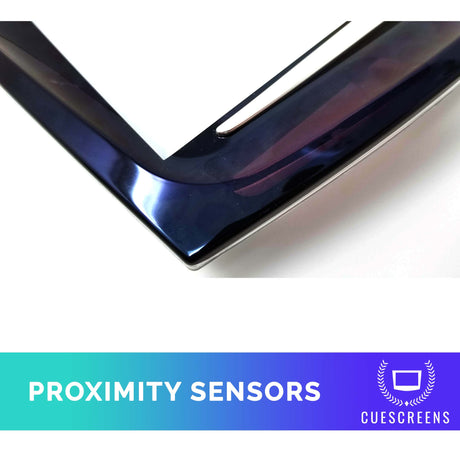
![[Premium] Upgraded Gel-Free Cadillac CUE Replacement Touch Screen Display-Cuescreens. Supports Proximity Sensors.](http://www.cuescreens.com/cdn/shop/files/7c1892_7faa9297eab444d5a99838357b9c178c_mv2.png?v=1764720901&width=460)