Modern vehicles rely on touchscreens for everything—from navigation and media to climate controls and safety features. When the screen fails, it’s not just annoying—it can make your vehicle harder (and sometimes unsafe) to operate.
Why Car Touchscreens Fail So Frequently
Touchscreens weren’t designed for the environment they live in. Over time, several unavoidable factors work against them.
1. Heat Is the Biggest Enemy
Vehicle interiors regularly hit extreme temperatures. Prolonged heat exposure causes:
- Adhesive layers to weaken
- LCD panels to delaminate
- Digitizers to lose accuracy
This is why many screens fail gradually—starting with ghost touches or delayed response before going completely dark.
2. Digitizers Wear Out Before Displays
In most cases, the touch layer fails before the screen itself. Common signs include:
- Touching one area triggers another
- Parts of the screen stop responding
- Random inputs while driving
Once this starts, software updates won’t fix it—it’s a hardware problem.
3. Vibration and Electrical Stress
Daily driving introduces constant vibration, while infotainment systems draw power continuously. Over time this leads to:
- Ribbon cable fatigue
- Micro-cracks in solder joints
- Intermittent screen resets
These failures often show up as “sometimes works, sometimes doesn’t” behavior.
4. It’s Rarely Just Software
Dealerships often default to “software issues,” but persistent freezing, flickering, or black screens are almost always physical failures. If rebooting helps only temporarily, the hardware is already compromised.
Common Symptoms of Touchscreen Failure
If your vehicle is showing any of the following, the touchscreen itself is likely failing:
- Screen goes black but audio still works
- Ghost touches or delayed response
- Display fades or flickers when warm
- Screen only works in cold weather
- CarPlay or Android Auto crashes the system
These issues don’t reverse on their own—and they usually get worse.
Why Dealership Repairs Are So Expensive
Most dealerships don’t repair touchscreens. They replace entire infotainment assemblies, which means:
- High parts costs
- Proprietary programming fees
- Labor-intensive installs
It’s not unusual to see quotes between $1,500 and $4,000+, even when only the screen itself has failed.
The Smart Way to Fix a Failed Touchscreen
Full OEM Replacement
- Factory part
- Extremely expensive
- Often uses the same failure-prone design
Aftermarket Head Units
- Requires dash modification
- Can break factory integrations
- Install quality varies widely
Targeted Screen Replacement (What Most Drivers Actually Need)
In many vehicles, replacing only the touchscreen restores full functionality—without cutting wires or losing factory features.
This approach:
- Keeps OEM integration intact
- Avoids invasive installs
- Costs a fraction of dealership repairs
You can learn more about how this works in our guide to OEM touchscreen replacement options.
Why Screen Quality Matters
Not all replacement screens are equal. Poor-quality panels often:
- Have lower brightness and contrast
- Use inferior digitizers
- Fail again within a year
High-quality replacements are engineered specifically for automotive conditions—heat, vibration, and daily use.
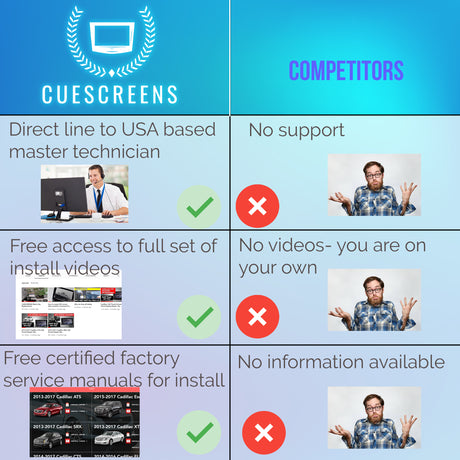
If you’re already dealing with ghost touch or black screen issues, our breakdown of Cuescreens vs Knockoffs explains why quality makes such a difference.
Can You Prevent Touchscreen Failure?
You can’t eliminate wear entirely, but you can slow it down:
- Use a windshield sunshade in hot weather
- Avoid harsh cleaners or ammonia-based sprays
- Let the cabin cool before heavy use
- Don’t ignore early symptoms
And if your screen has already failed, choosing the right replacement the first time matters. Our plug-and-play touchscreen solutions are designed to fix the problem—not repeat it.
Bottom Line
Touchscreens fail because they’re pushed beyond what they were originally designed to handle. Heat, vibration, and time eventually win.
But a failed touchscreen doesn’t mean your vehicle is outdated—or that you need to spend thousands at the dealership. With the right replacement approach, you can restore full functionality, keep factory features, and get back on the road without unnecessary hassle.
![[Premium] Upgraded Gel-Free Cadillac CUE Replacement Touch Screen Display-Cuescreens](http://www.cuescreens.com/cdn/shop/files/7c1892_b5fcaf040dfe42abb289e47b1fa91ab9_mv2.png?v=1738265347&width=460)


![[Premium] Upgraded Gel-Free Cadillac CUE Replacement Touch Screen Display-Cuescreens. Supports Proximity Sensors.](http://www.cuescreens.com/cdn/shop/files/7c1892_7faa9297eab444d5a99838357b9c178c_mv2.png?v=1764720901&width=460)