If your GMC Sierra infotainment screen is acting “possessed” — tapping buttons by itself, freezing, or showing dead touch zones — you’re dealing with one of the most common IntelliLink failures GM truck owners face. The good news: in most cases, the problem is fixable without replacing the entire radio.
This guide breaks down the most common GMC Sierra IntelliLink touchscreen problems, what causes them, how to confirm the issue, and what the permanent fix looks like.
Common GMC Sierra IntelliLink Screen Failure Symptoms
Most Sierra owners notice the problem gradually, then suddenly it becomes impossible to ignore. The most common symptoms include:
- Ghost touch (phantom taps): the screen presses buttons on its own, changes stations, opens apps, or calls contacts.
- Dead spots: certain areas of the screen stop responding to touch.
- Freezing and lag: the system becomes slow, locks up, or resets randomly.
- Delamination / bubbling: visible bubbles, hazing, or “wet-looking” areas inside the screen.
- Touch misalignment: you tap one area and it registers somewhere else.
If your screen is selecting items you didn’t touch, that’s typically not a software glitch — it’s usually a failing touch layer.
Why GMC Sierra IntelliLink Screens Fail
The IntelliLink screen is a layered assembly. Over time, the touch-sensitive layer (digitizer) can degrade and start sending false inputs to the system. This is especially common in vehicles exposed to high heat, direct sun, and large temperature swings.
1) Touch Digitizer Failure (Most Common Cause)
When the digitizer begins failing, it can generate phantom touches, create dead zones, or become erratic. This is the #1 driver of “ghost touch” in the Sierra.
2) Heat-Related Delamination
Repeated heating and cooling can weaken adhesives and cause the screen layers to separate, resulting in bubbling, haze, and poor touch accuracy.
3) Power/Connection Issues (Less Common)
Loose connectors or grounding issues can cause intermittent behavior, but they are far less common than touchscreen layer failures.
4) Software Issues (Usually Secondary)
Software can freeze, but persistent ghost touch and physical bubbling are almost always hardware-related. Updates can help stability, but they don’t repair a failing digitizer.
Quick Checks to Confirm It’s the Touchscreen
Before replacing anything, use these quick checks to confirm whether your Sierra’s touchscreen is the problem:
- Does the display still power on normally? If yes, the head unit is likely fine.
- Does ghost touch happen even after restarting the truck? If yes, likely digitizer failure.
- Is it worse after sitting in the sun? Heat correlation often points to delamination/digitizer issues.
- Do you see bubbles, haze, or separation? That’s a strong indicator the screen layers are failing.
- Are certain buttons impossible to press? Dead zones are a classic digitizer symptom.
If these match what you’re seeing, you’re almost certainly dealing with touchscreen failure. You can find replacements for the GMC Sierra Intellilink here.
Dealership vs. Permanent Fix
What dealerships typically recommend
Dealers often quote replacing the entire infotainment unit or screen assembly. This can be expensive, and it’s frequently more than what’s needed.
The permanent fix (what actually solves the root cause)
In most cases, the permanent solution is to replace the failing touchscreen component with a quality replacement matched to your Sierra’s exact screen version.
When done correctly, replacement resolves:
- Ghost touch / phantom taps
- Dead spots and unresponsive touch
- Touch calibration drift
- Delamination-related touch issues
Common Mistakes to Avoid
- Endless resets: if it’s hardware failure, resets will only help temporarily (if at all).
- Cheap no-name parts: inconsistent touch response and premature failure are common.
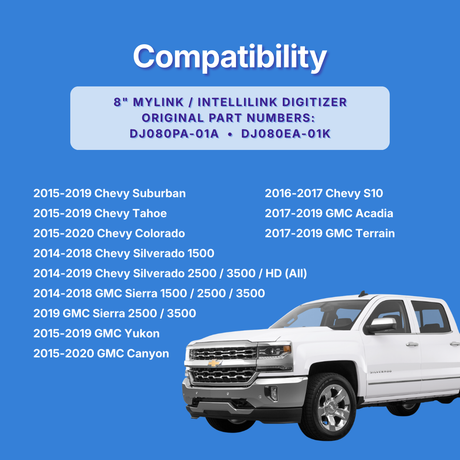
- Ordering without confirming your exact model: Sierra screens vary by year/trim and infotainment package.
- Rushing installation: dust, fingerprints, or pressure points can lead to poor results.
Which GMC Sierra Models Are Affected?
IntelliLink touchscreen failures are widely reported across Sierra model years that share similar infotainment hardware. This issue is common enough that it is frequently searched by owners looking for a permanent fix.
The most important factor is not just the year — it’s the infotainment system type and screen configuration.
Tip: Always verify your exact screen version before ordering replacement parts.
FAQ: GMC Sierra IntelliLink Touchscreen Problems
Is ghost touch a software problem?
Almost never. Persistent ghost touch is most commonly caused by a failing touchscreen digitizer.
Why does it get worse in the heat?
Heat accelerates adhesive breakdown and touchscreen layer separation, and it can make failing touch sensors behave more erratically.
Do I need to replace the entire infotainment unit?
In many cases, no. The radio/head unit often still functions properly — the touchscreen layer is what fails.
Can I keep driving with it?
You can, but it can be distracting. These issues usually worsen over time.
Tl;DR
If your GMC Sierra IntelliLink screen is ghost-touching, bubbling, freezing, or developing dead spots, you’re not alone — it’s a very common failure platform. The good news is that most Sierra screen failures have a permanent fix without replacing the entire unit.
Confirm your screen configuration, replace the failing touchscreen component with a quality matched replacement, and your Sierra’s infotainment should feel normal again.
About the Author
Daniel Gigante has over 18 years of experience in the automotive industry, with a focus on vehicle technology, infotainment systems, and real-world reliability. He writes about automotive design, touchscreen usability, and how modern technology impacts everyday driving.
![[Premium] Upgraded Gel-Free Cadillac CUE Replacement Touch Screen Display-Cuescreens](http://www.cuescreens.com/cdn/shop/files/7c1892_b5fcaf040dfe42abb289e47b1fa91ab9_mv2.png?v=1738265347&width=460)


![[Premium] Upgraded Gel-Free Cadillac CUE Replacement Touch Screen Display-Cuescreens. Supports Proximity Sensors.](http://www.cuescreens.com/cdn/shop/files/7c1892_7faa9297eab444d5a99838357b9c178c_mv2.png?v=1764720901&width=460)