If you own a 2018-2020 Hyundai Tucson and your infotainment screen has started bubbling, peeling at the edges, or showing a cloudy film across the display, you are dealing with touchscreen delamination. It is one of the most reported issues on Tucson models from this generation, and it has nothing to do with how the vehicle was used or maintained. It is a structural failure built into how the factory screen was assembled.
If you have a 2016 or 2017 Tucson, or a 2021 Tucson, please note: the replacement screen in this guide is confirmed for 2018-2020 models specifically. The 2021 Tucson moved to a significantly redesigned interior and infotainment system, and 2016-2017 models may use a different screen generation. Compare your factory screen's part number carefully before ordering, or contact Cuescreens support at info@cuescreens.com or 563-289-7276 if you are unsure which screen your vehicle has.
This guide explains what delamination is, why it happens on the Tucson, how to confirm that is what you are seeing, and what your actual fix options are.
What Is Touchscreen Delamination?
The infotainment screen in your Tucson is not a single piece of glass. It is a layered assembly made up of the LCD panel, a digitizer (the touch-sensing layer), and an outer protective glass or film. These layers are bonded together using an optically clear adhesive.
Delamination occurs when that adhesive breaks down and the layers begin to separate. Air gets trapped between them, forming bubbles. The separation usually starts at the edges and works inward over time. The result is a screen that looks cloudy, shows visible bubbles or air pockets, and can become partially or fully unresponsive to touch.
It is a manufacturing defect rooted in adhesive formulation, not driver error. Hyundai used an adhesive in many of their 8-inch infotainment screens that degrades with heat cycling over time. In climates with hot summers or cold winters, the process speeds up. Many Tucson owners first notice it around the 4-6 year mark.
How to Confirm Your Tucson Has Delamination
Delamination on the Tucson infotainment screen looks like one or more of the following:
- Visible air bubbles beneath the screen surface, usually starting near the bezel or corners
- A cloudy, hazy, or oily-looking layer that does not wipe away
- The display looks fine when off but shows the separation when backlit
- Touch inputs work in some areas but not others, or the screen registers touches in the wrong location (ghost touch)
- A visible dark border or shadow forming around the edges of the screen
If the screen is completely black and not turning on, that is a different failure mode. Delamination is specifically a visual and touch degradation issue where the screen still powers on but the image quality and touch response have deteriorated.
Which Tucson Models Are Affected
The delamination issue is most commonly reported in 2018-2020 Tucson models equipped with the 8-inch infotainment display. This covers both the base and higher trim levels that came with the larger screen. The OEM part number associated with this screen is 96160 S8700, with additional compatible numbers including 96160 D9220 and the LA080WV9 digitizer variants.
The 2018-2020 Hyundai Tucson is specifically listed as the supported fitment for the replacement screen described below. If you have a 2016, 2017, or 2021 Tucson, see the note above before ordering.
What the Dealer Will Tell You
Most Tucson owners who bring this to a dealership are told the entire head unit needs to be replaced. At a dealer, that repair typically runs $2,000 to $3,000 or more once you factor in parts and labor. In many cases, the warranty has already expired by the time delamination becomes visible, so the cost falls entirely on the owner.
Hyundai did not issue a widespread technical service bulletin covering delamination for Tucson models the way some other manufacturers have handled similar issues. That leaves owners either paying dealer rates or finding an alternative repair path.
The Right Fix: Replace the Screen Assembly
The only real solution to delamination is replacing the failed screen assembly. Attempting to clean or re-bond the layers at home is not practical and does not produce lasting results because the adhesive itself has structurally failed.
The good news is that replacing just the LCD and digitizer assembly, rather than the entire radio unit, costs a fraction of what a dealer charges and keeps your factory settings, presets, and programming fully intact.
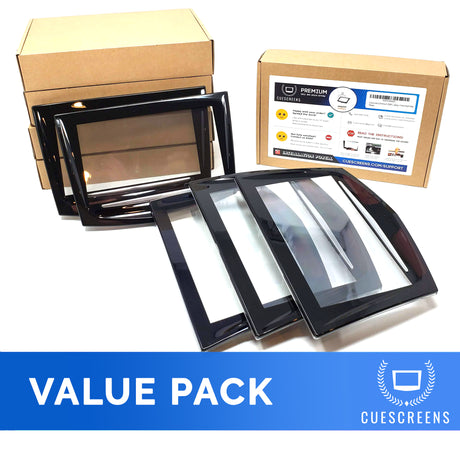
The Cuescreens 8-inch Kia and Hyundai LCD Touchscreen Replacement is a direct-fit solution built specifically for this application. It includes both the LCD panel and touchscreen digitizer as a single pre-bonded assembly, which is what makes installation straightforward. You remove the original screen, swap over any brackets as needed, and plug in the new unit. No programming. No dealer calibration. No head unit replacement.
Key features of this replacement screen:
- Complete LCD and digitizer assembly, plug-and-play installation
- Patented gel-free construction that eliminates the adhesive failure point responsible for the original delamination
- Automotive-grade tempered glass for improved durability
- OE-matched dimensions and connectors for direct fitment
- Upgraded touch chipset for fast and accurate response
- No programming or dealer visit required after installation
- Standard 2-year warranty with a Lifetime warranty upgrade option
At $199, this replacement screen saves Tucson owners well over $1,500 compared to the dealer alternative.
DIY or Professional Installation
Installation on the Tucson typically takes 30-45 minutes using basic tools. Because the LCD and digitizer come pre-bonded as a single unit, there is no need to work with gel or adhesive during the install, which is what makes it accessible for a home mechanic.
If you prefer to have it done professionally, Cuescreens works with a network of over 2,000 installers nationwide. You can find one near you at cuescreens.com/pages/store-locator.
Frequently Asked Questions
Will this fix ghost touch along with the delamination?
Yes. Ghost touch and unresponsive zones are caused by the same layer failure as delamination. Replacing the full screen assembly resolves both issues.
Do I need to reprogram anything after installation?
No. This is a direct hardware swap. All of your existing settings, radio presets, Bluetooth pairings, and vehicle-specific configurations remain intact. There is nothing to program.
How do I confirm compatibility with my Tucson?
Verify that your vehicle is a 2018-2020 Hyundai Tucson with the 8-inch factory infotainment display. Cross-reference your factory screen's part number with 96160 S8700 or the additional compatible numbers listed on the product page before ordering.
Is the replacement screen new or refurbished?
Cuescreens sells only new screens. No refurbished, remanufactured, or pulled units.
What if I have a 2016, 2017, or 2021 Tucson?
This replacement screen is confirmed for 2018-2020 models. The 2021 Tucson moved to a significantly redesigned interior and infotainment system, and 2016-2017 models may use a different screen. Compare your factory screen's part number carefully before ordering, or contact Cuescreens support at info@cuescreens.com or 563-289-7276 if you are unsure.
Bottom Line
Hyundai Tucson touchscreen delamination is a known adhesive failure, not a fluke and not something you caused. If your 2018-2020 Tucson's screen is bubbling, hazing, or developing ghost touch issues, the screen assembly has failed and needs to be replaced. Paying dealer prices for a full head unit swap is not your only option.
The Cuescreens replacement screen for the Hyundai Tucson is a new, plug-and-play unit built to fix exactly this problem at a fraction of the dealer cost.
About the Author: Daniel Gigante has over 18 years of experience in the automotive industry, with a focus on vehicle technology, infotainment systems, and real-world reliability. He writes about automotive design, touchscreen usability, and how modern technology impacts everyday driving.
![[Premium] Upgraded Gel-Free Cadillac CUE Replacement Touch Screen Display-Cuescreens](http://www.cuescreens.com/cdn/shop/files/7c1892_b5fcaf040dfe42abb289e47b1fa91ab9_mv2.png?v=1738265347&width=460)


![[Premium] Upgraded Gel-Free Cadillac CUE Replacement Touch Screen Display-Cuescreens. Supports Proximity Sensors.](http://www.cuescreens.com/cdn/shop/files/7c1892_7faa9297eab444d5a99838357b9c178c_mv2.png?v=1764720901&width=460)