If your car's touchscreen is bubbling, responding to touches you didn't make, or has a sticky residue leaking out of the bezel, OCA adhesive failure is the most likely cause. It's one of the most common reasons factory infotainment screens fail — and most drivers have no idea it's happening until the symptoms are already severe.
Here's what OCA actually is, why it fails in automotive environments, and what you can do about it.
What Is OCA?
Optical Clear Adhesive is a transparent adhesive used to bond the layers of a touchscreen together. In a typical automotive infotainment screen, there are at least three layers stacked on top of each other: the outer cover glass, the digitizer (the touch-sensing layer), and the LCD panel underneath. OCA is what holds those layers together as a unified assembly.
OCA comes in two main forms. The most common in older factory automotive applications is a gel-based liquid adhesive — sometimes called LOCA (Liquid Optically Clear Adhesive) — that is applied between layers and then cured using UV light or heat. A dry film version also exists and is used in some applications, applied under pressure without the need for curing.
The reason OCA is used instead of ordinary adhesive comes down to optics. When two surfaces with different refractive indexes are separated by air, light scatters at the boundary. That scattering reduces brightness, contrast, and readability. OCA fills the air gap between layers with a material that has a refractive index close to glass, which allows light to pass through cleanly. The result is a sharper, brighter display with better visibility in direct sunlight.
In a consumer electronics environment — a phone kept in a pocket, a tablet used indoors — OCA holds up well. The problem is that a car's interior is a completely different operating environment.
Why Car Dashboards Are Hard on OCA
A parked car in direct summer sun is one of the harshest thermal environments a consumer product can experience. Dashboard surfaces can reach 157°F to 200°F depending on conditions and location. On a 90-degree day, the interior air temperature can hit 120°F or more within 30 minutes of parking. And this happens repeatedly, every day, for years.
Factory OCA formulations used in many automotive infotainment screens were not engineered to withstand this kind of repeated thermal cycling. As the adhesive heats and cools cycle after cycle, it slowly degrades. The process looks like this:
First, heat softens the adhesive. OCA that is gel-based can become fluid at elevated temperatures, which allows it to shift position within the assembly. Once it shifts, the bond between layers is no longer uniform.
Second, the layers themselves expand and contract at different rates. The cover glass, the digitizer, the plastic frame, and the LCD panel all have different thermal expansion coefficients. Under heat, they pull away from each other slightly. If the adhesive has already softened, it can't maintain the bond across that gap.
Third, UV exposure compounds the problem. For screens that are positioned to receive direct sunlight through the windshield, ongoing UV exposure accelerates chemical degradation of the adhesive over time, making it brittle or causing it to lose adhesion even when cool.
The result is delamination: the layers physically separate. Air gets trapped between them. The touch sensor loses calibration. Eventually, the adhesive can liquefy entirely and seep out of the screen assembly.
What OCA Failure Looks Like
OCA failure has a predictable progression. Catching it early makes a difference in what you're dealing with by the time you do something about it.
Bubbles or cloudy patches. The first visible sign is usually air pockets forming under the glass, showing up as bubbles or a milky haze in certain areas of the screen. This is the adhesive separating and allowing air in between layers.
Ghost touches. When the digitizer loses contact with the glass, it can register phantom inputs. The screen appears to press buttons, change settings, or scroll on its own. This is often the symptom that frustrates drivers most, because it happens while driving and can't be dismissed as a minor cosmetic issue.
Dead zones. In areas where the digitizer has fully separated from the glass, touch input stops working entirely. You'll press a part of the screen and get no response.
Gel leaking from the bezel. In advanced cases, the adhesive liquefies and drips from the edges of the screen onto the center console. At this stage the screen is past the point of any temporary fix.
Which Vehicles Are Affected
OCA failure is not specific to one manufacturer. Any factory infotainment screen that uses a gel-based digitizer construction is potentially vulnerable, given enough heat exposure and time. That said, some platforms have been more widely reported than others.
Jeep, RAM, Chrysler, and Dodge vehicles with Uconnect 8.4" screens are among the most commonly discussed. The gel-based digitizer construction in those screens has been well documented as a failure point in hotter climates. Cadillac CUE systems are also frequently reported, as are Chevrolet and GMC MyLink screens, Hyundai and Kia infotainment systems, Subaru, and Mazda.
The common thread is not the brand — it's the construction method. Screens built with gel-based OCA are at risk. Screens built without it are not.
What Actually Fixes It
Temporary approaches like windshield sun shades, DIY glue kits, or heat and pressure tricks can slow progression or hide symptoms briefly, but they don't repair the adhesive layer that has already failed. Once the gel has shifted or separated, there is no way to restore the original bond without disassembling the screen.
Dealerships typically recommend replacing the entire head unit, which can cost $1,700 to $3,500 or more. In most cases, that's unnecessary. The radio's electronics are usually fine. The failure is in the screen itself.
The permanent fix is replacing the touchscreen with a unit that uses a gel-free construction. Without an OCA gel layer, there's nothing to melt. Cuescreens replacement screens are built this way — each one is a direct-fit LCD and digitizer assembly designed for the specific vehicle, without the gel-based bonding that causes factory screens to fail over time.
If your screen is bubbling, ghost touching, or showing dead zones, you can search by your vehicle to find the right replacement:
Replacing the screen takes the OCA failure mode off the table entirely — and keeps you from paying dealer prices for electronics that aren't broken.
Frequently Asked Questions
What is Optical Clear Adhesive (OCA)?
OCA is a transparent adhesive film or gel used to bond the layers of a touchscreen together — typically the cover glass, digitizer, and LCD panel. It eliminates the air gap between layers to improve brightness, contrast, and touch accuracy.
Why does OCA adhesive melt in car touchscreens?
Car dashboards can reach 160°F or higher in direct sun. Most factory OCA formulations were not designed to withstand repeated thermal cycling at those temperatures. Over time, heat causes the adhesive to soften, shift, and eventually separate from the layers it was bonding.
What does OCA failure look like?
Common signs include bubbles or cloudy patches under the glass, ghost touches (the screen activating on its own), dead zones that won't respond to input, and in severe cases, a sticky gel leaking from the screen bezel.
Can you fix OCA adhesive failure without replacing the whole radio?
Yes. In most cases you only need to replace the touchscreen itself, not the entire head unit. Cuescreens replacement screens use a gel-free construction that eliminates OCA as a failure point entirely.
Which vehicles are most affected by OCA failure?
Jeep, RAM, Chrysler, and Dodge vehicles with Uconnect screens are among the most commonly reported. Cadillac CUE systems, Chevrolet and GMC MyLink screens, Hyundai, Kia, Subaru, and Mazda infotainment systems have also shown OCA-related failures.
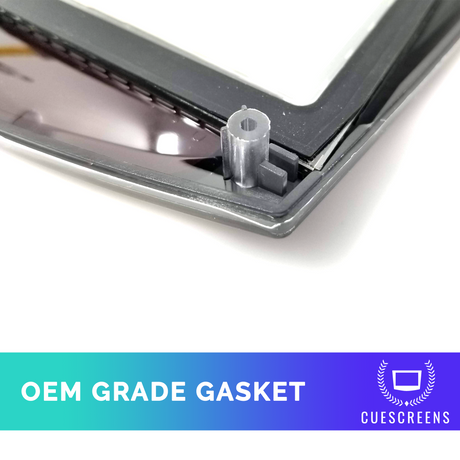
![[Premium] Upgraded Gel-Free Cadillac CUE Replacement Touch Screen Display-Cuescreens](http://www.cuescreens.com/cdn/shop/files/7c1892_b5fcaf040dfe42abb289e47b1fa91ab9_mv2.png?v=1738265347&width=460)


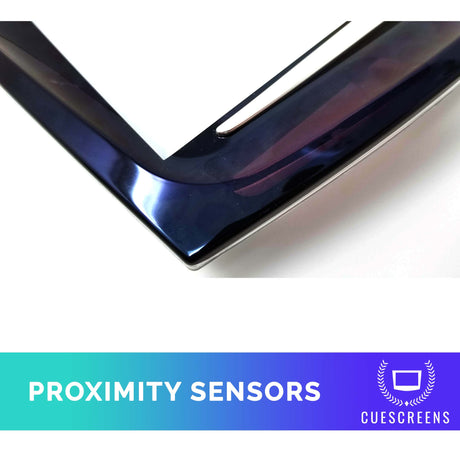
![[Premium] Upgraded Gel-Free Cadillac CUE Replacement Touch Screen Display-Cuescreens. Supports Proximity Sensors.](http://www.cuescreens.com/cdn/shop/files/7c1892_7faa9297eab444d5a99838357b9c178c_mv2.png?v=1764720901&width=460)