If your Chrysler Pacifica's Uconnect screen has gone black, started showing bubbles, or is registering touches you never made, you are dealing with one of the most documented infotainment failures in the minivan segment. These problems show up well before the vehicle is worn out, and they affect everything from navigation and backup camera to audio and climate control. Here is what actually causes them.
Digitizer Delamination: The Most Common Cause
The factory Uconnect screen is built in layers: an outer digitizer (the touch sensor) bonded to an inner LCD using an adhesive called Liquid Optically Clear Adhesive, or LOCA. Over time, heat and UV exposure cause this adhesive to break down. When it fails, the layers separate.
The first sign is usually a bubble or air pocket forming at a corner or edge of the screen. As delamination spreads, the screen develops ghost touches (random inputs with no one touching it), dead zones that stop responding, or it stops working entirely. On Chrysler Pacifica models, the failure pattern is typically center bubbles that spread outward.
This is a physical failure of the screen assembly. A software reset will not fix it. The only permanent solution is replacing the digitizer and LCD assembly.
Software Glitches and Firmware Bugs
Not every screen failure is hardware. Uconnect is known for software bugs that cause the display to freeze, go black, or reboot. Apple CarPlay and Android Auto disconnecting, navigation locking up, and Bluetooth pairing failures are all common software-side problems.
A hard reset -- holding the Volume and Tuning knobs simultaneously for about 10 seconds with the vehicle on but engine off -- can sometimes clear these. Dealership-installed software updates have addressed some known bugs, though they require a service visit.
If your screen goes black but the radio and HVAC still function, a software glitch or power delivery problem is the more likely cause rather than delamination.
Power Supply and Fuse Problems
A blown fuse will cut power to the display entirely. The infotainment fuse is the first thing to check when the screen goes completely dark. Beyond the fuse, loose wiring harness connections behind the head unit are another source of intermittent failures -- the screen works sometimes, then stops for no obvious reason.
There is also a documented failure mode where a faulty radio module does not shut down properly, causing a parasitic battery drain even when the vehicle is off. This has been linked to an internal chip failure on the radio's main board and can contribute to repeated screen reboot cycles.
Heat and Environmental Damage
Heat accelerates every failure mode on this list. Dashboard temperatures inside a parked vehicle can reach extremes that accelerate adhesive breakdown in the screen layers and stress the electronics inside the head unit. Electromagnetic interference from a faulty phone charger or nearby device can also disrupt system operation, though this is a less common cause.
A Known Defect Across Multiple Model Years
Uconnect screen failures are not isolated incidents. Class action lawsuits have been filed and investigated against Fiat Chrysler Automobiles alleging that Uconnect systems in 2017 through 2023 Chrysler Pacifica models are defective. The alleged defect causes the radio, touchscreen, GPS, rearview backup camera, theater system, and Bluetooth to malfunction. Attorneys investigating the issue have noted that the problem extends across Pacifica, Dodge Durango, Ram, and Jeep Grand Cherokee owners across multiple model years.
What Does It Mean for the Infotainment System?
When the Uconnect screen fails, it is not just an inconvenience. Navigation, backup camera, audio controls, Bluetooth, and in many Pacificas, rear theater system controls -- all run through that screen. Losing it affects real driving functionality, not just entertainment.
The Fix: Screen Replacement, Not Head Unit Replacement
Dealers often recommend replacing the entire head unit when the screen fails. That repair can cost $1,900 or more. The head unit itself is not usually the problem -- the screen assembly is. Replacing only the LCD and digitizer assembly restores full functionality without the dealer markup, and because the head unit stays in place, no reprogramming is required.
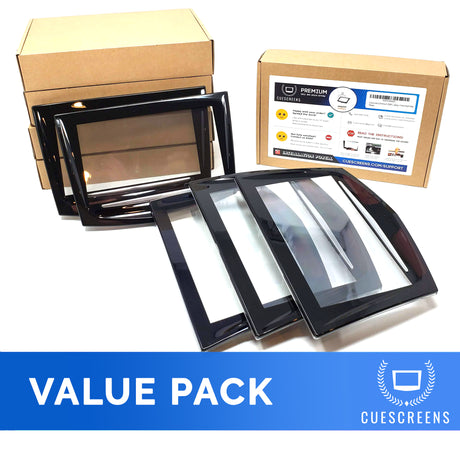
Cuescreens offers a gel-free replacement screen assembly designed to eliminate the adhesive failure point that causes delamination in the first place. The upgraded design uses a QuantumCore chipset for stable, responsive touch performance and installs in about an hour without special tools.
If your Pacifica Uconnect screen is showing bubbles, ghost touches, or a black display, the screen assembly is almost certainly the problem -- not the entire infotainment system. Replacing the screen is the fix.
Frequently Asked Questions
Why does my Chrysler Pacifica Uconnect screen go black?
A black Uconnect screen is most often caused by a software glitch, a blown fuse, or a loose wiring connection behind the infotainment unit. In some cases, a faulty radio module can also drain the battery and cause the screen to lose power.
What causes bubbles on my Pacifica Uconnect screen?
Bubbles are caused by delamination. The adhesive layer between the outer digitizer and the inner LCD breaks down from heat and UV exposure. Once the adhesive fails, the layers separate and the screen becomes unresponsive or develops ghost touches.
Is Uconnect screen failure a known defect on the Chrysler Pacifica?
Yes. Class action lawsuits have been filed and investigated against FCA alleging that Uconnect systems in 2017 through 2023 Chrysler Pacifica models are defective, causing screens to freeze, go black, or lose navigation and backup camera functionality.
Can I replace the Pacifica Uconnect screen myself?
Yes. A replacement LCD and digitizer assembly can be installed without dealer programming because you are replacing only the screen assembly, not the head unit. The head unit stays in place and remains paired to the vehicle.
![[Premium] Upgraded Gel-Free Cadillac CUE Replacement Touch Screen Display-Cuescreens](http://www.cuescreens.com/cdn/shop/files/7c1892_b5fcaf040dfe42abb289e47b1fa91ab9_mv2.png?v=1738265347&width=460)


![[Premium] Upgraded Gel-Free Cadillac CUE Replacement Touch Screen Display-Cuescreens. Supports Proximity Sensors.](http://www.cuescreens.com/cdn/shop/files/7c1892_7faa9297eab444d5a99838357b9c178c_mv2.png?v=1764720901&width=460)