You tap the volume icon and the screen skips to navigation. You press a button at the top of the screen and something in the middle activates. Your inputs are landing in the wrong place, and it is getting worse over time.
This is called calibration drift, and it is one of the most misunderstood problems in aging car infotainment systems. Most owners assume it is a software issue. They try factory resets, firmware updates, and recalibration procedures. Some of those things help temporarily. None of them fix it permanently, because the root cause is not software.
Here is what is actually happening inside the screen -- and why recalibrating a worn digitizer is like adjusting the aim on a broken instrument.
How a Car Touchscreen Knows Where You Touched
To understand drift, you first need to understand how touch detection works.
The display in your infotainment system is made up of several layers. The LCD produces the image you see. In front of the LCD sits the digitizer, a thin transparent panel whose entire job is to detect where your finger is and report those coordinates to the infotainment software.
Most modern car touchscreens use capacitive digitizers. A capacitive digitizer works by generating a stable electrostatic field across a conductive coating -- typically Indium Tin Oxide, or ITO -- on the surface of the glass. When your finger touches the screen, it disturbs that field at a specific location. The touch controller chip reads the disturbance, calculates the X and Y coordinates, and sends that data to the infotainment system. The software then maps those coordinates to whatever button or control is displayed at that position on the LCD behind it.
This mapping is what calibration is. The factory sets it once so the coordinates the digitizer reports line up precisely with the visual elements on the LCD. When the hardware is new and intact, this works perfectly. When the hardware starts to age and degrade, the mapping breaks down.
What Happens to the Digitizer Over Time
Car dashboards are a particularly harsh environment for precision electronics. Cabin temperatures in direct sunlight routinely exceed 150 degrees Fahrenheit in summer. In winter, the same car sits at well below freezing. This thermal cycling happens thousands of times over the life of a vehicle, and it takes a measurable toll on every layer of the display assembly.
Adhesive Breakdown
In many factory infotainment screens, the digitizer is bonded to the LCD behind it using an optically clear adhesive. This adhesive holds the two layers in precise alignment so the touch surface and the visual display stay registered to each other.
Over years of heat cycling, that adhesive weakens and softens. When it begins to fail, the digitizer can shift slightly relative to the LCD. The touch controller is still reporting coordinates based on the digitizer's sensing field, but those coordinates no longer line up with the image behind it. A tap that the controller reads as coordinate X is now visually landing somewhere different on the screen. That offset is calibration drift.
In more advanced cases, the adhesive fails enough that air pockets form between the digitizer and the display. This shows up visually as bubbling or a cloudy area under the glass, and it typically signals that dead zones and ghost touch are coming next.
Conductive Layer Degradation
On older resistive touchscreens, which were common in infotainment systems through the mid-2010s, drift happens differently. Resistive screens use two conductive ITO layers separated by a small air gap. When you press the screen, the top flexible layer bends down and makes contact with the bottom layer, completing a circuit at the touch point.
Over time and with repeated use, the ITO coating on the flexible top layer develops microscopic cracks from constant bending. The resistance across the layer changes unevenly as the coating deteriorates. Because the touch controller calculates position by measuring voltage across this resistive surface, changes in the coating's resistance throw off the coordinate calculations. The screen starts registering inputs slightly away from where you actually touched, and the error grows as the coating continues to degrade.
Resistive screens also require periodic recalibration precisely because of this known drift behavior. It is an inherent limitation of the technology that the automotive industry largely moved away from -- but millions of vehicles with older resistive digitizers are still on the road.
Thermal Expansion and Contraction
Even without visible adhesive failure or cracking, thermal cycling alone gradually works on the digitizer assembly. Different materials in the display stack expand and contract at different rates with temperature changes. The glass, the conductive coating, the adhesive, and the display panel behind it all have different thermal properties. Over thousands of heat-cool cycles, these differences create stress at the boundaries between layers and can cause microscopic shifts in alignment that add up to measurable drift over the life of the screen.
This also explains a common complaint: a screen that works acceptably when the car is cold but shows significant offset or ghost inputs after the cabin heats up. The drift is there in both conditions, but heat makes it worse by further softening adhesive and expanding layers that are already out of alignment.
Why Recalibration Only Goes So Far
Most modern infotainment systems include a touchscreen calibration procedure, either accessible through the settings menu or a hidden diagnostic mode. Recalibration resets the touch controller's reference points -- it essentially tells the system where the corners and center of the active touch area are, and adjusts the coordinate mapping accordingly.
For minor drift caused by a software reference that has gotten out of sync, recalibration works and sticks. This is the case for some drift that develops after a software update or system reset.
For drift caused by physical degradation of the digitizer layer, recalibration provides temporary improvement at best. The procedure resets the mapping, but the hardware condition that produced the drift has not changed. The adhesive is still failing. The conductive layer is still degraded. The layers are still slightly misaligned. Drift returns, usually faster each time, because you are retuning a reference against a surface that is continuing to change.
A factory reset has the same limitation. It restores software to default settings but has no effect on the physical state of the display assembly.
When Drift Progresses to Dead Zones and Ghost Touch
Calibration drift is usually an early symptom of a digitizer that is on a failure trajectory. Left unaddressed, the degradation that causes drift typically progresses in a predictable direction:
- Taps register slightly off-target in one area of the screen
- The offset becomes consistent and reproducible rather than random
- Ghost touch begins as the degraded digitizer generates false input signals
- Dead zones appear where sections of the sensing surface stop registering entirely
- Touch function fails across larger areas until the digitizer is effectively unusable
The rate of progression depends on the vehicle, how much direct sun and heat the screen is exposed to, and how far along the underlying adhesive or conductive layer degradation has already gone. Some screens drift for years before reaching dead zones. Others move through the stages quickly once the adhesive begins to fail in earnest.
What Actually Fixes It
If calibration drift is being caused by physical degradation of the digitizer, the permanent fix is replacing the digitizer. Recalibration adjusts the software mapping. Replacing the digitizer restores the intact sensing surface that accurate mapping depends on.
In most vehicles, the digitizer is a separate component from the LCD. The display image is still produced by the LCD behind it, which is typically still working fine. Replacing only the digitizer -- rather than the full display assembly or the entire head unit -- restores accurate touch response at a fraction of the cost of what a dealership will typically quote for the same repair.
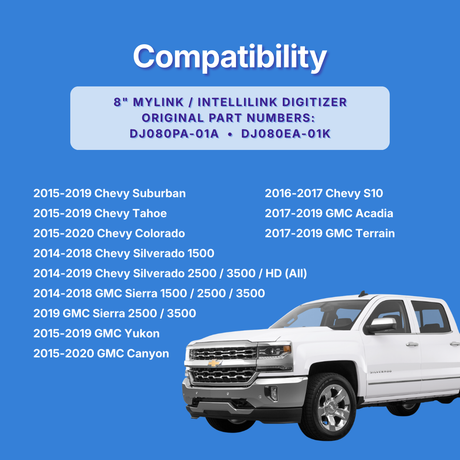
Cuescreens makes direct-fit replacement digitizers for a wide range of vehicles. If your screen is drifting, registering inputs in the wrong place, or developing ghost touch, the digitizer is almost certainly the cause.
Find your vehicle's replacement digitizer at Cuescreens
Frequently Asked Questions
What causes touch calibration drift in car infotainment screens?
Calibration drift is almost always caused by physical degradation of the digitizer layer, not a software problem. On resistive screens, the conductive ITO coating on the flexible top layer degrades with repeated flexing and heat exposure, causing the touch controller to misread input coordinates. On capacitive screens, drift is typically caused by adhesive breakdown that allows the digitizer to shift relative to the LCD, disrupting the coordinate mapping.
Why does my car touchscreen feel off-center or register taps in the wrong place?
When taps register away from where you actually touched, the touch controller is calculating input coordinates based on a reference that no longer matches the physical state of the digitizer. On older resistive systems this happens as the conductive layer's resistance changes with age. On capacitive systems it typically happens when the digitizer has partially separated from the display, shifting the touch surface relative to the LCD image behind it.
Can recalibrating the touchscreen fix the problem?
Recalibration can provide temporary relief by resetting the touch controller's reference points. If the underlying digitizer is physically degraded or has separated from the display, recalibration does not fix the root cause. The drift will return because the hardware condition causing it has not changed.
Why does my car touchscreen drift worse on hot days?
Heat accelerates digitizer failure. Dashboard temperatures in direct sun can exceed 150 degrees Fahrenheit. At high temperatures, the adhesive bonding the digitizer softens and the conductive sensing layer expands. This shifts the touch controller's readings. A screen that works acceptably when cool may show significant offset, ghost touch, or dead zones after the cabin heats up.
Is calibration drift the same as a dead spot?
They are related but different. Calibration drift is when inputs register in the wrong location. A dead spot is when a section of the screen stops registering input entirely. Both are symptoms of digitizer degradation. Drift often appears first and progresses to dead zones as the digitizer continues to fail.
What actually fixes calibration drift in a car touchscreen?
If the drift is caused by physical degradation of the digitizer, the only permanent fix is replacing the digitizer. Recalibration and factory resets address software references, not hardware condition. A replacement digitizer restores the intact sensing surface the touch controller needs to accurately read input.
![[Premium] Upgraded Gel-Free Cadillac CUE Replacement Touch Screen Display-Cuescreens](http://www.cuescreens.com/cdn/shop/files/7c1892_b5fcaf040dfe42abb289e47b1fa91ab9_mv2.png?v=1738265347&width=460)


![[Premium] Upgraded Gel-Free Cadillac CUE Replacement Touch Screen Display-Cuescreens. Supports Proximity Sensors.](http://www.cuescreens.com/cdn/shop/files/7c1892_7faa9297eab444d5a99838357b9c178c_mv2.png?v=1764720901&width=460)